How to read divinatory tarot cards
You have always been fascinated by clairvoyance, ever since you understood that its various practices can help us live better. So you took a closer interest in it, in particular by initiating yourself into cartomancy and divinatory tarot<\/strong>.
And today, now that you know the meanings of the many cards making up your tarot deck<\/strong>, you wish to put into practice<\/strong> what you have learned, and begin to perform readings<\/strong>.
But there are many of them, and you do not know which one to start with to make your first predictions of the future. Here are a few examples of card spreads<\/strong> that are the simplest to perform on your own, or for a querent.
Having your cards firmly in hand
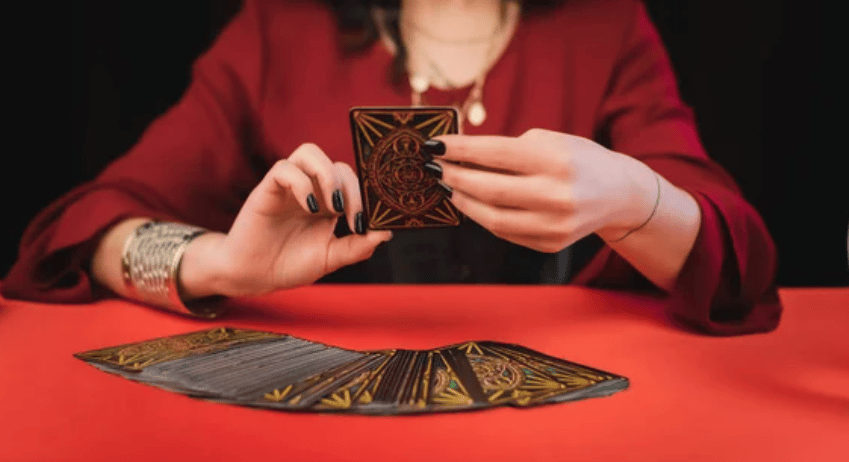
Before you can tell yourself that you are ready(e) to set out on card spreads, you must indeed become one(e) with your own deck of cards<\/strong>.
This means you must know it by heart<\/strong>. That you must know how to interpret the meanings of each of its cards<\/strong>, so that they no longer hold any secrets for you. But that is not all, for beyond the mental exercise, you will need to practise physically holding your cards<\/strong> between your hands. You will therefore have to handle<\/strong> them with skill and ease<\/strong>, so that you can be as at ease as possible when you find yourself performing a reading<\/strong> in front of a querent.

You will therefore only be ready once you possess within you the knowledge of the meanings of all your cards<\/strong>, and once you master your deck of cards with confidence<\/strong> between your hands.
What is more, you must take great care of the latter, and do not lend it nor let it pass into other hands<\/strong> under any pretext. For it belongs to you<\/strong>. You have grown accustomed to it over time, but it too has grown accustomed to you, to your instinct and your open, clear-sighted mind. It is therefore to you that it will henceforth be able to respond when you question it during future readings.
The most basic reading method
It is true that it is recommended to start with the Marseille tarot deck, which is the most complete and the most telling when one begins the divinatory art through the tarot cards<\/strong>. Once you are therefore familiar with your Marseille tarot deck<\/strong>, with each of its major arcana<\/strong> so highly symbolic in their representations, but also with its 56 minor arcana<\/strong>, just as important, for they are filled with many details concerning the querent, then you will be able to access<\/strong> one of the simplest readings<\/strong> to perform:
- The cross spread<\/strong>.
You should know that each reading method<\/strong> answers a specific situation<\/strong>, and that in the case of the cross spread<\/strong>, you will be entitled only to one single answer<\/strong> to a question asked. This makes it the most basic<\/strong> reading to perform, though it is among the most effective<\/strong>.
The Marseille tarot cross spread
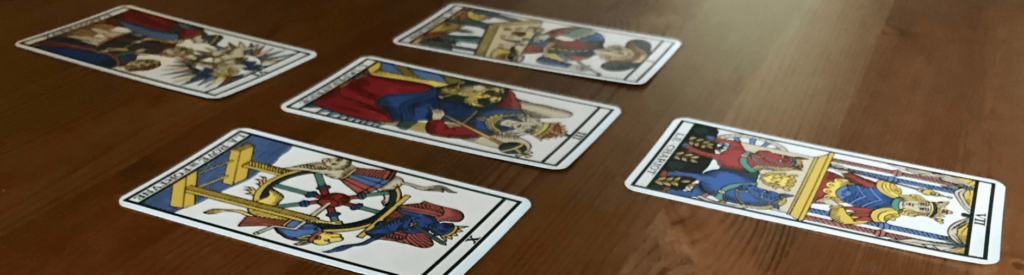
When you are starting out, and you are a little novice with readings, you may as well start only with the 22 major arcana<\/strong>, which will be telling enough to answer the question asked.
The Marseille tarot cards,<\/strong> also called the blades<\/strong>, must be shuffled together<\/strong>, so that they are mixed as well as possible. This step is important, which is why it must be repeated many times<\/strong>. Some even go so far as to shuffle the cards 7 times in a row<\/strong>, to be sure that the deck is completely dispersed.
Then you will cut your deck of cards into 2 roughly distinct parts with your left hand<\/strong>, to keep only the 2 cards found beneath each of the 2 piles<\/strong>.
These 2 cards<\/strong>, once turned over and placed before you<\/strong>, will give you a glimpse of the present moment<\/strong> thanks to their interpretations<\/strong>.
Once you have taken stock of the atmosphere, then, you will reflect on the question you wish to ask your cards.
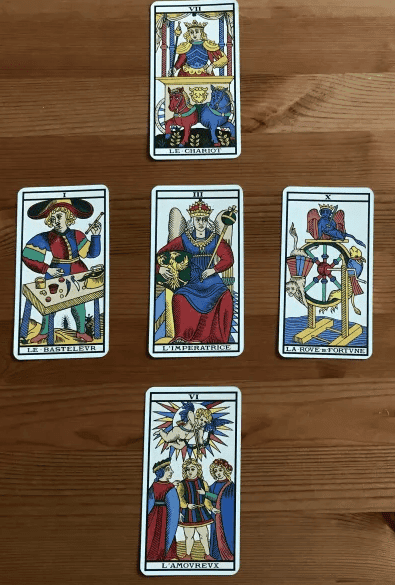
Then you will reshuffle the 2<\/strong> piles together, then you will draw 5 cards<\/strong> face down, which you will lay flat one after another in a very precise place, and in the order in which they came out.
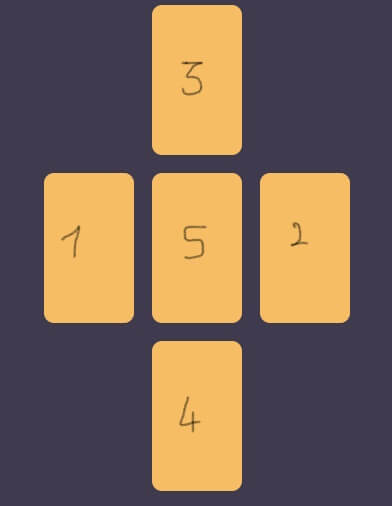
Thus, the 1st<\/sup> of the cards drawn will be placed completely to the left, the second completely to the right, the 3rd<\/sup> at the top and in the middle, the 4th<\/sup> at the bottom and in the middle, and the 5th<\/sup>, right in the middle of the other 4.<\/em>
So that your cards thus arranged form a cross. It is then that the interpretation of the cards can begin<\/strong>.
We are therefore going to uncover each of them in order<\/strong>, and interpret them according to their symbolism and meanings<\/strong>, but also according to the place they occupy within the cross.
- The 1st<\/sup> card will represent the current situation<\/strong>; it tells you whether the situation is rather positive or negative.
- The 2nd<\/sup> card speaks to you of blockage or, on the contrary, of a surge forward.
- The 3rd<\/sup> card concretely reveals to you an event to come<\/strong> in the near future.
- The 4th<\/sup> card is the one that answers the question<\/strong> asked thanks to its meaning.
- As for the 5th<\/sup> of these blades, it offers a kind of analysis of what the other 4 have just revealed. It helps to make better use of, or to draw lessons from, the answer provided by the interpretation and the placement of these 5 cards within the cross.
Other spreads with other divinatory tarots
Once you have got the hang of the cross spread<\/strong> of the Marseille tarot, nothing stops you from stepping up a gear with other spreads<\/strong>. Indeed, there are many ways to draw the cards with this tarot. Here are a few examples:
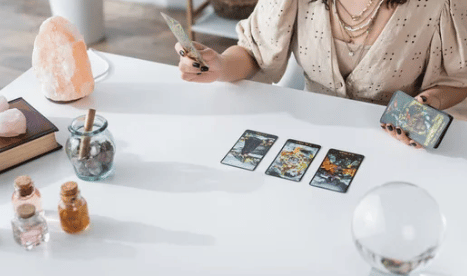
- The 3-blade spread<\/strong>: 3 cards drawn, then, laid out in a line in front of you. Once turned over, the 1st<\/sup> will come back to facts belonging to your past, the second will dwell on a present situation, and the third will reveal to you a future event to come upon your destiny.
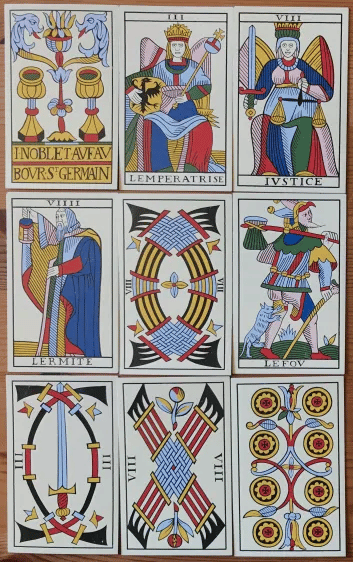
- The square spread<\/strong>: 9 cards will be drawn then laid out in lines of 3 across 3 levels, so that they form a square. The top line will speak to you of your positive points. The middle line will guide you along the road to follow, by revealing the obstacles that will be found there. As for the bottom line, it will express projects to come.
- The pyramid spread : More complex; once the 6 cards are drawn<\/strong> and placed in the form of a pyramid<\/strong>, the interpretation will be done as follows: The 1st<\/sup> card<\/strong> sitting enthroned at the top will speak to you of the current situation<\/strong>. The 2 cards of the second line will evoke obstacles<\/strong> or benefits to come upon your projects. As for the 3 cards of the 3rd<\/sup> line, they will reveal the concrete answer<\/strong> to your question.
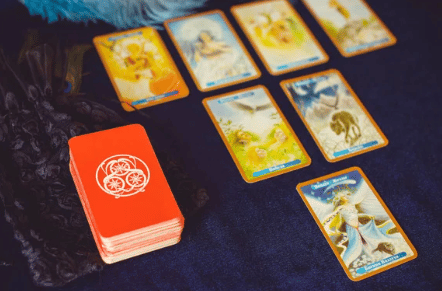
There are others such as the Celtic cross spread<\/strong> or that of the astrological wheel<\/strong>, but they are too numerous to detail them all here. And all the other divinatory tarots<\/strong> such as the Rider-Waite<\/strong> or the Oracle of Belline<\/strong>, to name but a few, are interpreted with similar spreads<\/strong> or more singular ones. In any case, they all have the particularity of answering a question asked<\/strong>, or of predicting one’s future<\/strong> for a querent, according to the spreads used.
SOMMAIRE