
Virtues of the Tiger’s Eye Stone
Tiger’s eye is one of the fine stones best known to the general public. While its chatoyancy makes it particularly prized in jewellery, crystal healers seek it out above all for its protective virtues.
Tiger’s eye wards off dangers and negative entities. It shines with its warmth and strength. Fashionable in the West since the early 19th century, the traditions surrounding this stone date back to Antiquity. Here you will find the answers to all your questions about tiger’s eye and its virtues in crystal healing.

Tiger’s Eye: its virtues and properties in crystal healing
| Nom scientifique | Pseudocrocidolite |
| Lieux d’extraction | Australie, Afrique du Sud, Brésil, Chine, Inde, Namibie, USA |
| Couleur | Brun-jaune |
| Chakras | 3me Œil (Ajna), Plexus Solaire (Manipura), Sacré (Svadhistana), Racine (Muladhara) |
| Signes astrologiques | Gémeaux, Lion, Vierge, Capricorne |
| Vertus énergétiques | Protection, enracinement |
Nature and composition of the tiger’s eye stone
Le pseudocrocidolite, or tiger’s eye, belongs to the mineral family of silicates. It is composed of a mixture of oxygen and silica. Like all other quartzes, Georgius Agricola characterised it during the 16th century. The father of mineralogy thus distinguished several minerals that had previously been confused with one another.
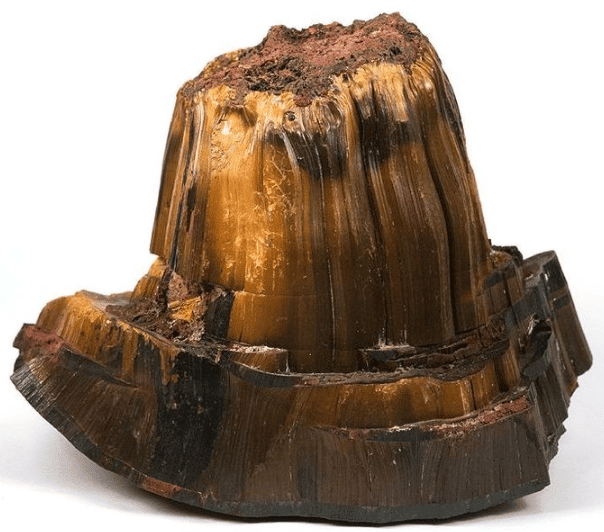
The exact nature of tiger’s eye is nevertheless debated today within the scientific community. Long regarded as a microcrystalline quartz, some recent studies present it instead as a macrocrystalline variety. It is over its formation that the scientific dispute revolves.
No products found.
A natural formation
In its natural state, tiger’s eye forms within alkaline granites, syenites and their pegmatites. Produced by a slow cooling of magma, these plutonic rocks provide an exceptional geological setting. They favour the formation of crystals of remarkable size.
The clash of two theories
The most commonly accepted thesis assumes a pseudomorphism of tiger’s eye. Silica crystals progressively replace its crocidolite crystals, a fibrous variety of riebeckite. They drive them out and at the same time create an iron-rich residue. The latter oxidises and becomes incorporated into the quartz veins. It is this that gives this fine stone its so characteristic chatoyancy.
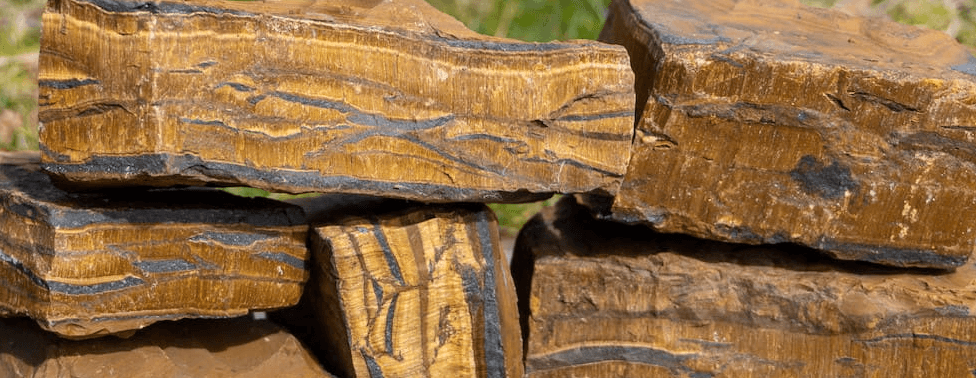
The second theory, born of recent research, presents tiger’s eye as the result of synchronous growth. Its quartz and its crocidolite grow together. The former forms by columnar crystallisation, the latter as a fibrous mass. It is then the latter that creates the chatoyancy of tiger’s eye.
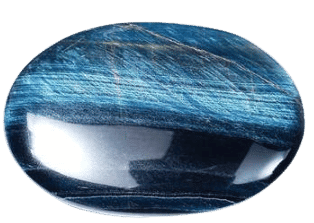
Whatever the exact theory, the iron that makes up the crocidolite oxidises progressively. It takes on a blue colour, characteristic of the hawk’s eye.
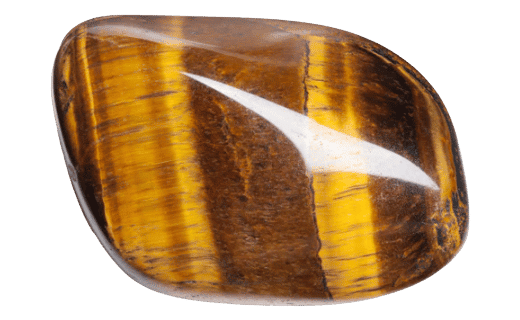
If natural alteration continues, the iron transforms into limonite or hematite and turns yellow-brown. Tiger’s eye is thus fully formed.
If the stone is heated to above 150°, it becomes a bull’s eye with a red colour.
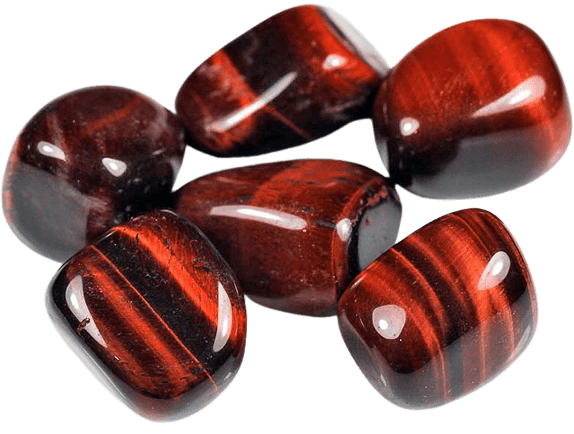
A common group of fine stones
The mineral family of quartzes represents 12% of our lithosphere. They are found in various forms. The purest regularly yield renowned crystals and fine stones of repute. But silicates often mingle with other geological elements. They make up numerous terrestrial rocks that are common: granite, gneiss, sand, sandstone, etc.
A prolific family in crystal healing
Quartzes are prized in crystal healing. They possess numerous virtues specific to each variety. Crystal healers turn to:
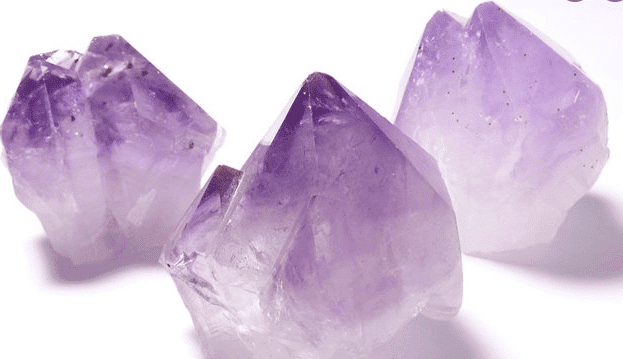
- the monocrystalline quartzes. The crystals that compose them are invisible to the naked eye. This category includes rose quartz, smoky quartz, amethyst, citrine, ametrine, hematoid quartz, etc.;
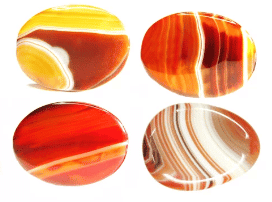
- the polycrystalline quartzes. They form from chalcedony. They include agate, jasper, onyx, carnelian, bloodstone, chrysoprase, etc.
Characteristics of the tiger’s eye stone
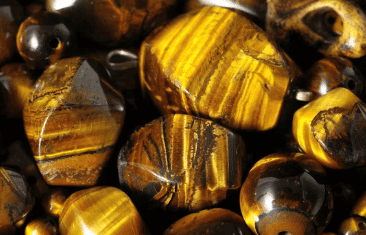
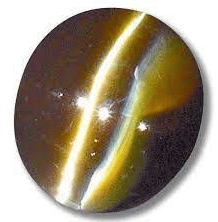
Tiger’s eye takes its common name from its so distinctive chatoyancy. The fine stone bears an uncanny resemblance to the coppery, golden gaze of the eponymous big cat. Unmistakable among all stones, it nevertheless possesses few mineral properties. This is why it remains overlooked by science.
Recognising tiger’s eye
Tiger’s eye is easily identified. Its exceptional brown-yellow reflections intrigue the eye. Its characteristic chatoyancy, caused by its fibrous inclusions, distinguishes it readily from other quartzes. It can, however, be confused with a variety of chrysoberyl: cymophane, a precious stone nicknamed cat’s eye.
A solid fine stone
Like all quartzes, tiger’s eye has a hardness of 7 on the Mohs scale. Its density falls within the average for silicates, ranging between 2.64 and 2.71. A piece of jewellery made from this fine stone has little to fear from knocks and falls.
Extraction and modern use of the tiger’s eye stone
Tiger’s eye is a fine stone that is relatively common across the planet. Highly valued in crystal healing, demand has soared in recent years. While alternative medicines attribute many virtues to it, science and industry grant this quartz crystal no particular property. Even though it is easily synthesised, its abundance in the natural state makes this process pointless.
A natural extraction
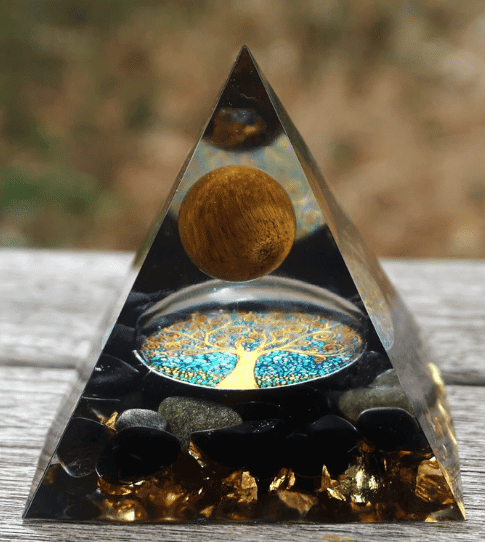
Tiger’s eye is found in quantity all over the planet, except in Europe. Each deposit yields fine stones of singular quality and appearance. The largest are located:

- in Western Australia, at Wittenoom Gorge;
- in South Africa, in the Cape, Griqualand and the Kalahari. These are the most heavily worked deposits on the planet;
- in Brazil, in Minas Gerais;
- in China, in Hunan. This deposit yields a particular variety of pietersite;
- in India;
- in Namibia, in the Damaraland and Kunene regions where another variety of pietersite is also extracted;
- in the USA, in Arizona and California.

An industrial use of quartz
Industry regularly turns to the quartz family for its solidity. It proves ideal for designing street furniture or for industrial sandblasting. Nevertheless, tiger’s eye is not used for these purposes. Industry favours instead pure, synthetic hyaline quartz crystals, which are far less costly.
An aesthetic fine stone
At present, science recognises no physical virtue in tiger’s eye. It is its optical properties and its chatoyancy that have earned it since the 19th century the attention of the general public.
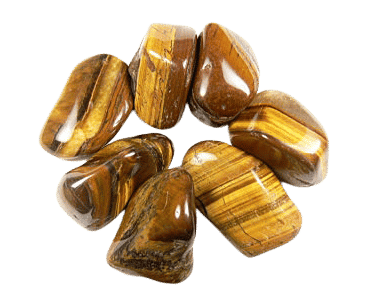
Visually close to cymophane, it makes an excellent substitute fine stone. It is indeed far less costly and more abundant across the planet.
Tiger’s eye through History
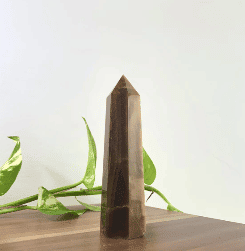
As there is no significant deposit of tiger’s eye in Europe, this stone has left little mark on the history of our continent. It is nevertheless present in various cultures.
Worn and appreciated by many peoples, humankind has credited it with virtues and benefits ranging from protection to clairvoyance.
Within the Fertile Crescent

At the beginning of Antiquity, the peoples of Mesopotamia extracted and shaped tiger’s eye. The unique chatoyancy of this stone evoked for them the eye of Bellus-Marduk.
Originally, this deity was linked to agriculture and exorcism.
Through the myths, it supplanted all the other gods and became the sovereign creator of the Babylonian pantheon.
Tiger’s eye was credited with protective virtues against malevolent entities and with powers linked to the fertility of the earth.
In the heart of the Nile valley
During the same period, the Egyptians crafted tiger’s eye jewellery, but also bull’s eye, hawk’s eye, cat’s eye and iron’s eye pieces.
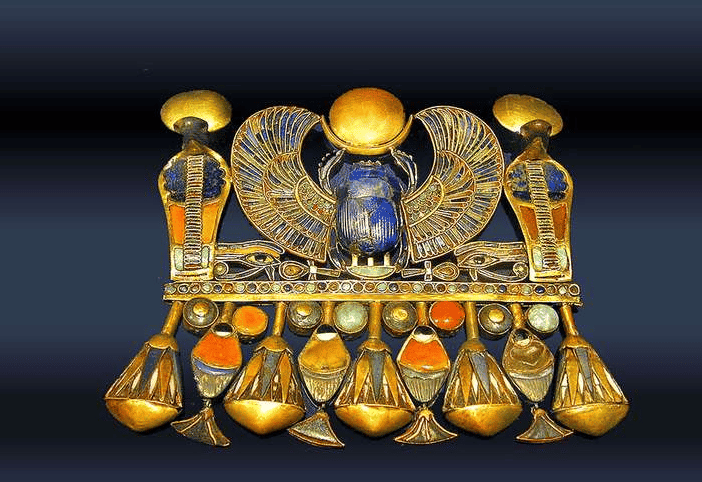
They did not distinguish between the various minerals with their « eyed » appearance . For the Egyptians, fibrous quartzes all represented the eye of Ra.
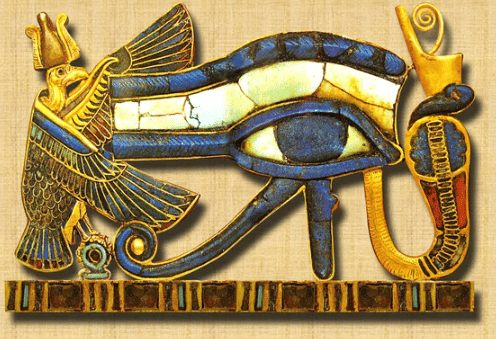
They credited all of these fine stones with powers of clairvoyance. They promise you clear vision, by day as by night, and a glimpse into the future and the past.
An ancient identification
For want of local deposits, tiger’s eye is absent from Greek myths and beliefs. However, thanks to export from Egypt and Mesopotamia, certain wealthy citizens occasionally beheld the fine stone. They then fashioned a few pieces of jewellery from it.
A Roman journey

During the conquest of Britannia, Roman soldiers got their hands on tiger’s eye stones. Discovered in tiny quantity at the bottom of a mine, these fine stones then travelled across the empire in the form of amulets. The soldiers credited them with protective virtues against wounds in battle.
In the Middle Ages, knights and soldiers still credited tiger’s eye with the same benefits. According to popular beliefs, it protected men against malevolent forces and spells.
Pigmentary properties
For centuries, the Japanese have used mineral pigments called Iwa-Enogu. To obtain them, they grind fine and semi-precious stones such as agate, jasper or tiger’s eye.
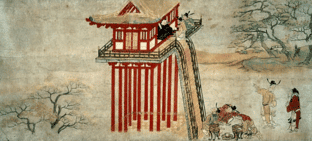
With an organic glue, painters apply them directly to their canvases. The minerals bring a very particular luminosity to the works. Paintings produced through this process withstand the passage of time particularly well.
The democratisation of tiger’s eye
In the 19th century, in Europe, tiger’s eye flourished. It was merchants who discovered it in the deposits of South Africa. They hastened to export it and to sell it at a premium price. Europeans regarded it as a precious stone.
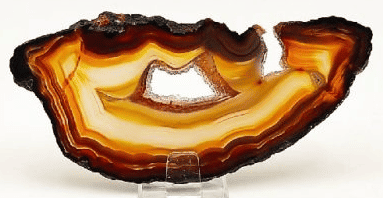
In the following years, the discovery of abundant mines led to the downgrading of tiger’s eye. It became a semi-precious stone, then a fine stone. It then became widespread in jewellery, gemcraft, ornaments and decoration. Its modest cost, its solidity and its unique appearance secured it remarkable popularity.
The symbols and spiritual connections of the tiger’s eye stone
Like all the fine stones used in crystal healing, tiger’s eye has left its mark on cultures throughout the world. Even in our modern era, it remains linked to traditional virtues and benefits. According to Islam, it attracts luck and success, while in Asia it harmonises yin and yang.
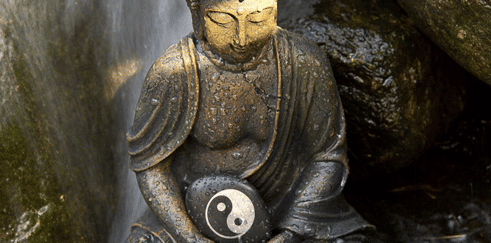
Tiger’s eye and the Buddhist chakras
In Buddhist traditions, the fine and semi-precious stones correspond to one or several chakras. They are an excellent aid to meditation or are worn as jewellery, always close to an energy centre. Tiger’s eye is a particular stone, linked to many chakras. Its singular vibratory strength indeed allows it to associate with several energy points. It stimulates:
- the 1st chakra, or the Root (Muladhara). Its influence stabilises you and gives you a feeling of comfort;
- the 2nd chakra, or the Sacral (Svadhisthana). It supports your vitality and your physical strength. It improves your recovery when you are injured or facing illness;
- the 3rd chakra, or the Solar Plexus (Manipura). If you place tiger’s eye on it, it strengthens your willpower, regulates your emotions and improves your self-esteem;
- the 6th chakra, or the Third Eye (Ajna). It calms your mind, amplifies your imagination, awakens your clairvoyance and balances your aura.

Tiger’s eye and the Western zodiac signs
Despite its relative absence in the West, tiger’s eye relates to several zodiac signs. Specialists assert that it favours:

- the Gemini. Born between 22 May and 21 June, this air sign reflects the purity of the gem;
- the Leo. Born between 24 July and 23 August, this fire sign symbolises the vitality of the big cat;
- the Virgo. Born between 24 August and 23 September, this earth sign evokes the stability offered by the stone;
- the Capricorn. Born between 22 May and 21 June, this earth sign recalls the resilience and solidity of quartz.
The tiger’s eye stone in alternative medicine
Each fine stone possesses a potential of its own. Drawing inspiration from traditional practices, alternative medicines develop methods that use the benefits of minerals and crystals.
Tiger’s eye is no exception. It is found across all the gentle disciplines. The latter value it particularly for its protective and stabilising virtues.
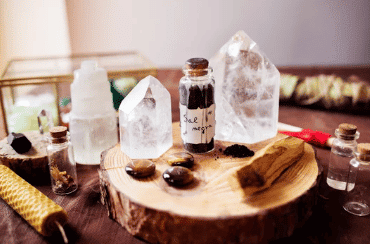
Crystal healing, an ancestral practice
Crystal healing is an alternative, complementary and non-conventional medicine. It draws its inspiration directly from age-old traditions and beliefs.
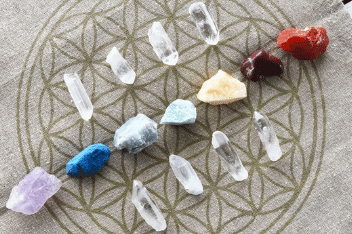
Not recognised by science, crystal healing treats the afflictions of your mind and your body. It uses stones and their energy vibrations.
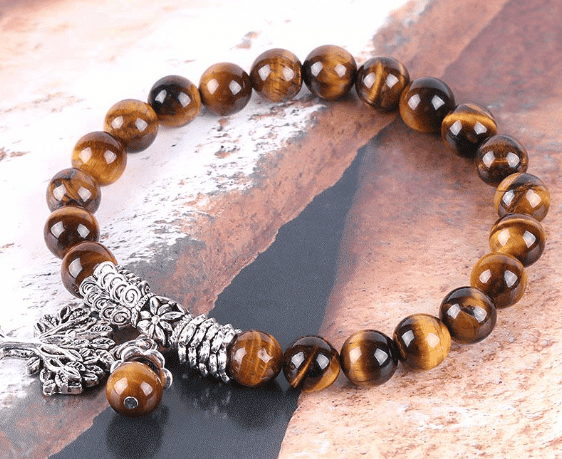
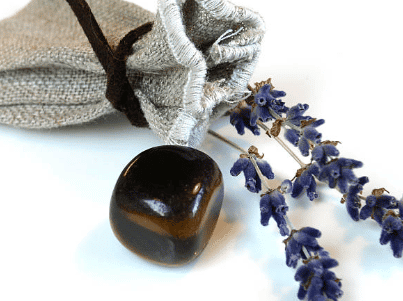
Bracelets, pendants and tumbled stones are specifically intended for this use. Thanks to them, you always keep your tiger’s eye with you and enjoy its benefits every day.
Caution: jewellery is not a substitute for traditional therapeutic treatment. Crystal healing is to be appreciated for its gentleness, but it never replaces the advice of a health professional. It only supports your healing by strengthening your body, your heart and your mind. Always consult a conventional doctor as a complement.
Radiesthesia, to diagnose and accompany
A popular divinatory process, radiesthesia detects emitted radiations. It is used as a diagnostic tool and accompanies practitioners of alternative medicines.
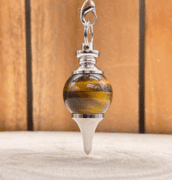
Using a pendulum, the dowser probes the body’s vibrations. He then interprets the values obtained on a Bovis chart.
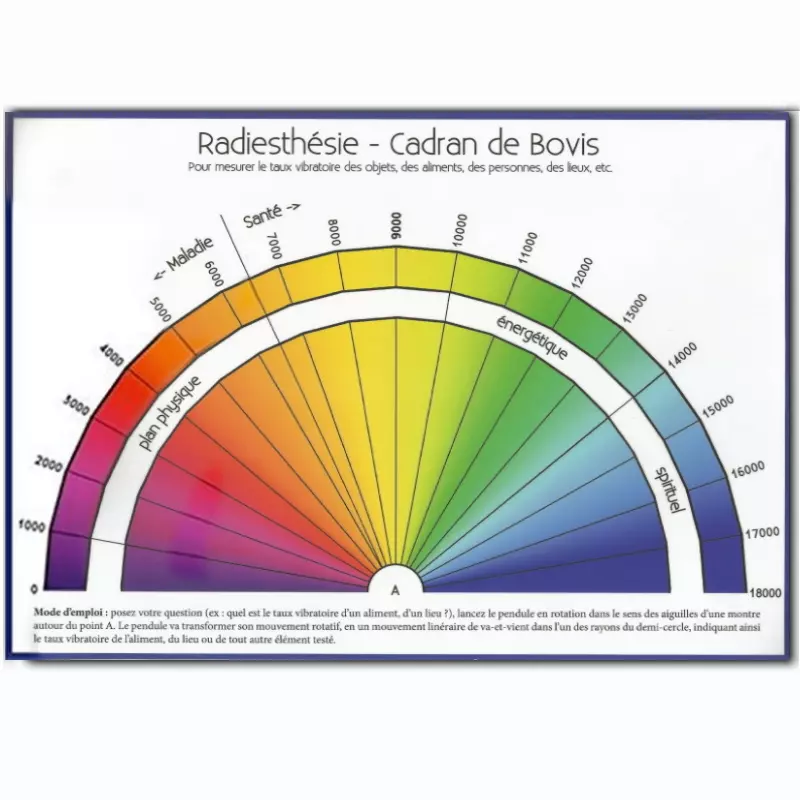
Linked to the balance of yin and yang, tiger’s eye proves effective in this discipline. Its virtues on the emotional body and on self-confidence strengthen the detection of ailments.
Feng shui, a preventive care at home
Feng shui, an age-old art originating in China, promotes your well-being. By harmonising the energy contained in the air, it purifies your living spaces and improves your overall health. Practitioners of feng shui attribute protective and purifying virtues to tiger’s eye.
Placing an imposing stone at the entrance of your home ensures its protection. It cleanses its atmosphere and diffuses its beneficial energies throughout your entire home.

Maintaining and revitalising your tiger’s eye stone
For them to remain effective, maintain your fine stones regularly. Remember to carry out the necessary rituals. Indispensable, they purify and recharge the vibratory energy of your rocks and crystals. Your tiger’s eye requires particular attention. Poorly maintained, it can become harmful to you.
The dangers of tiger’s eye
The power of your tiger’s eye can sometimes turn against you. For while it wards off outer negative energies, it also imprisons your own inside you.
Worn without interruption, especially at night, it throws your emotional body off balance.

After only a week, tiger’s eye turns into a poison for the circulation of your bodily energies. To sleep, we therefore advise you to remove the jewellery or the tumbled stones from your living space.
Cleansing your tiger’s eye
When it is empty of all energy, tiger’s eye has a natural tendency to absorb the surrounding negative energies. It then becomes charged with a harmful force that puts you in danger. More than any other fine stone, tiger’s eye must be purified regularly.

The cleansing ritual for your tiger’s eye is straightforward. As with the other quartzes, immerse it in distilled, salted water. Choose spring water for preference. In theory, three hours are enough. In a hurry? Then moving water, a river or a tap will guarantee you a result in less than a quarter of an hour.
If your stone is mounted on a metal piece of jewellery (a bracelet, a ring or a pendant), do not forget to dry it properly. Metal exposed to water, especially when salted, risks tarnishing or oxidising.
Recharging your tiger’s eye
As tiger’s eye belongs to the quartz family, recharging it proves simple. To restore its virtues to your stone, you need only expose it to the sun for a few hours, outdoors. Its power restores itself quickly. Perform this little ritual regularly. You will then enjoy all the more the virtues of your tiger’s eye.
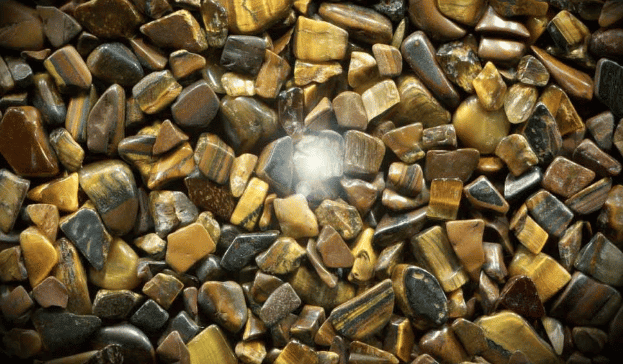
Virtues and benefits of the tiger’s eye stone
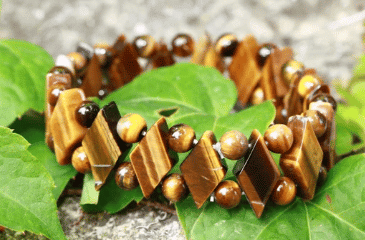

Crystal healers attribute numerous properties to tiger’s eye. It is the protective stone par excellence. It also revitalises and energises your body. To ward off malevolent energies, to drive them from your home or your body, rely on it.
There are many pieces of jewellery, in the form of bracelets and pendants, crafted from this fine stone. Day to day, they are an ideal aid to enjoy the crystal-healing benefits of tiger’s eye.
The virtues of combining tiger’s eye with other stones
Fine stones each possess their own virtues. Nevertheless, combined with other rocks and crystals, their benefits become further heightened. To multiply their positive effects, many designers compose for you bracelets and pendants with novel and original stone combinations.
As regards tiger’s eye, it pairs wonderfully with other protective stones : black tourmaline, labradorite, obsidian, pyrite, etc. The jewellery that brings them together forms true protective and impassable walls.
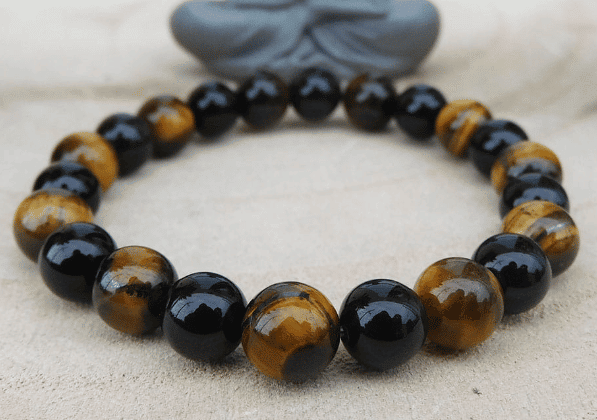
Another possible form of combination rests on colours.
- Warm stones that display hues similar to tiger’s eye, such as amber, sunstone or citrine, ally particularly well with it.
Finally, fine stones also combine according to their chakras that correspond.
Since tiger’s eye is linked to a large number of them, it associates with a variety of stones. It thus amplifies the benefits and virtues of carnelian, calcite, kyanite, lapis lazuli, amethyst, etc.

The psychological, spiritual and mental virtues of tiger’s eye
Tiger’s eye possesses numerous benefits. A formidable protective stone, it safeguards your mind from outside threats. When it comes to fighting negative energies and malevolent intentions, it is a specialist. Marked by its link to yin and yang, it harmonises your etheric body and restores your clarity of mind. On the mental level, tiger’s eye:
- strengthens your willpower;
- soothes your fears and your anxieties;
- fights against your mental blockages;
- improves your concentration;
- favours meditation;
- heightens your self-confidence;
- helps you overcome your shyness;
- helps to maintain a healthy relationship with yourself through introspection;
- stimulates your intuition;
- invigorates your sense of observation and your understanding.
The physical and bodily virtues of tiger’s eye
Tiger’s eye is a fighting, warm stone. Like the powerful big cat, it is defined by its physical strength and its exceptional vitality. It brings you excellent protection against physical afflictions. It also helps you to regenerate your body and to recover your courage. On the physical level, tiger’s eye:

- supports your sporting activities;
- favours physical exercise;
- loosens your joints;
- increases your reflexes;
- improves your vision, particularly at night;
- strengthens your digestive functions;
- protects you against the bacteria that attack your body;
- soothes your abdominal pains, particularly those linked to stress;
- calms your nerves and regulates them;
- slows down certain diseases, such as osteoarthritis;
- balances your hormones;
- warms your body by maintaining your blood circulation.
No products found.
You will also like




This page does not contain child posts!
SOMMAIRE