
Virtues of the Opal Stone
Recognised by the International Mineralogical Association (IMA), the name opal conceals a vast variety of crystals and minerals. The only shared feature of these gems is an optical property behind a spectacular prismatic iridescence. Transparent, glassy or opaque, this mineral family offers an impressive palette of colours.
The shimmering looks and plays of light of opalescent stones charm lovers of costume jewellery. Their lithotherapeutic properties are surprising! Marked by their diversity, they promise you many virtues acting on your three bodies. Here you will find the answers to all your questions about opal and its virtues in lithotherapy.
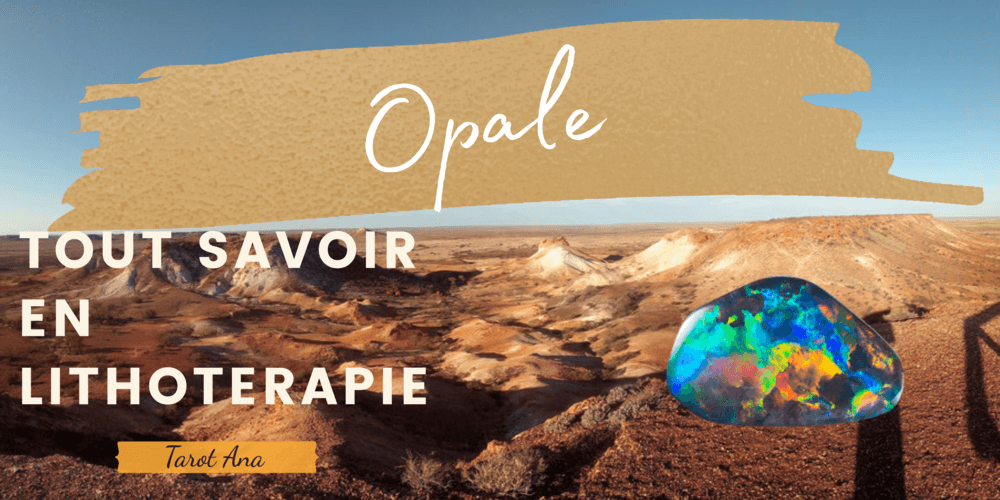
Opal: its virtues and properties in lithotherapy
| Appellations | Opale noire | Opale blanche | Opale verte | Opale cristal | Opale boulder | Opale matrix | Opale de feu | Opale dendritique |
| Lieux d’extraction | Australie, Éthiopie, Hongrie, République tchèque, Slovaquie | Australie, États-Unis, Honduras | Australie, Brésil, États-Unis, Hongrie, Inde, Madagascar, Mexique, République tchèque | Australie, Brésil, Éthiopie, Mexique, Pérou, Slovaquie | Australie | Australie, États-Unis, Honduras | Mexique, Guatemala | Kenya, Tanzanie |
| Chakras | Couronne (Sahasrana) | Couronne (Sahasrana) | Cœur (Anahata) | Sacré (Svadhistana) | Couronne (Sahasrana) | Sacré (Svadhistana) | Racine (Muladhara) | 3me Œil (Ajna) |
| Signes astrologiques | Taureau et Scorpion | Capricorne et Vierge | Balance et Bélier | Tous les signes du zodiaque | Verseau et Poissons | Verseau et Poissons | Lion et Sagittaire | Cancer et Gémeaux |
| Vertus énergétiques | Créativité, inspiration, imagination et mémoire | Stabilité et confiance | Protection des organes digestifs | Amour de soi | Harmonisation et déblocage énergétique | Enracinement et circulation énergétique | Ambition et résolution | Purification et renforcement physique |
Geological composition and formation of opals
Opal resembles no other stone used in lithotherapy. Far from monolithic, its family comprises various mineral species. Their geological composition and mode of formation prove varied.
No products found.
Three mineral species
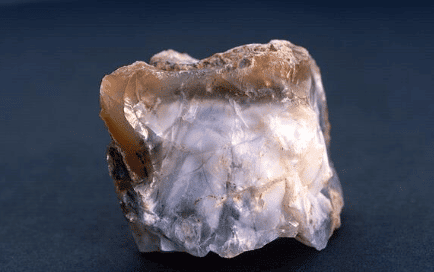
Opal is made up of three mineral species. The presence or absence of the first ones and the hydration of the last transform the nature, shape and colour of the gems. These minerals are:
- cristobalite. This silicon dioxide appears in acidic igneous rocks at high temperature. Present in meteorites, it is the main component of lunar rock;
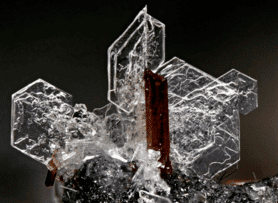
- tridymite. A hexagonal formation of silica, this polymorphic crystal belongs to the tectosilicate family. Its structure is close to that of quartz;
- a hydrated amorphous silica. Its water content ranges from 3 to 20%. Its presence is behind the internal plays of light of the opal.
Four great families of opals
Opals divide into four particular varieties according to their composition (cf. three mineral species). Mineralogists distinguish:
- opal-CT or lussatite. Rather rare and little exploited, its crystals discovered in France contain cristobalite and tridymite. They form by pseudomorphosis;
- opal-C. While it is made up almost exclusively of cristobalite, anomalies in its crystalline structure set it apart and place it within the family of opalescent rocks;
- opal-Ag. The majority of known opal species are of sedimentary origin and belong to this category. It is characterised by a strong presence of water molecules in the form of a gel;
- opal-An or hyalite. Composed essentially of silica, this type of amorphous gem contains little water. It forms within pegmatites and structures itself into networks.
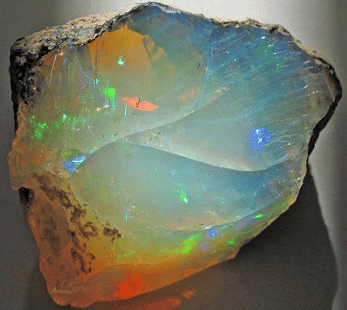
The various opals are: alumocalcite, diatomite, fiorite, forcherite, hydrophane, mascareignite, menilite, neslite and quincite.
A sedimentary formation in the clays
Sedimentary opals form at the end of a long process alternating between wet and dry periods.
During heavy rainfall, silica penetrates deep into the substrate. The clays then become saturated with water and turn impermeable. The mineral elements stagnate within them. Under the effect of a hydrolysis phenomenon, they precipitate and structure themselves into opal. The wealth of the many impurities present determines the chromatic palette and prismatic reflections of the gems. Iron, magnesium, calcium, aluminium, sodium and other minerals bring about the appearance of a precise hue.
At this point, plant or animal matter may mineralise into impressive inclusions. Some opals, such as the Australian ones from the Pandora deposit at Lightning Ridge, are composed exclusively of these fossilised organic materials.
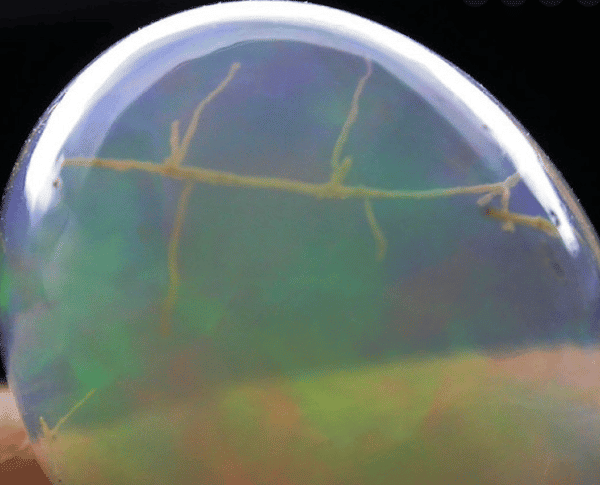
During periods of drought, the upper layers of the clays dry out. Evaporation drives the crystallisation of the remaining matter into chalcedony and quartz. They come to complete the opalescent rock.
A volcanic formation in the pegmatites
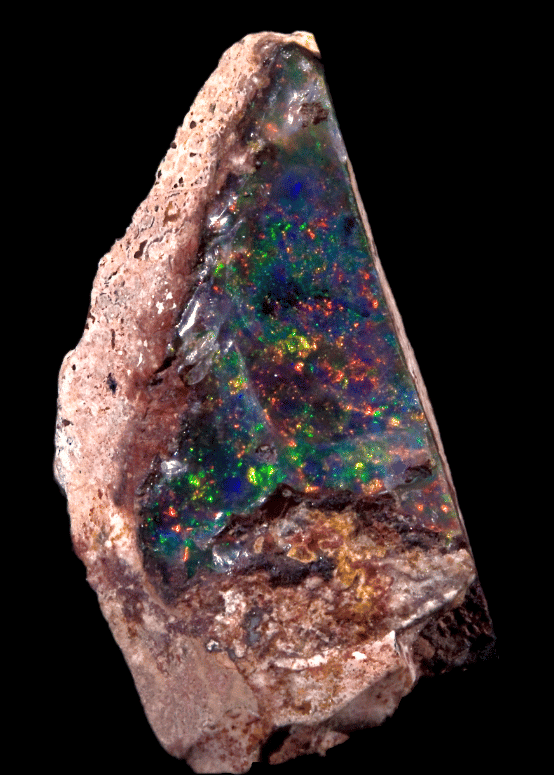
Volcanic opals appear at the end of a process similar to that of sedimentary opals. When a silicate magma rich in dissolved water cools, the granite solidifies. It ejects the unneeded minerals in the form of an aqueous mud: the pegmatite.
This in turn alternates wet and dry periods. The layers of silica superimpose and gradually form a stone. The mineral deposits present in the hydrothermal fluid determine its colours.
Natural exploitation and artificial creation of opals
Thanks to its great diversity, opal knows numerous methods of exploitation. The extraction methods partly explain its high price.
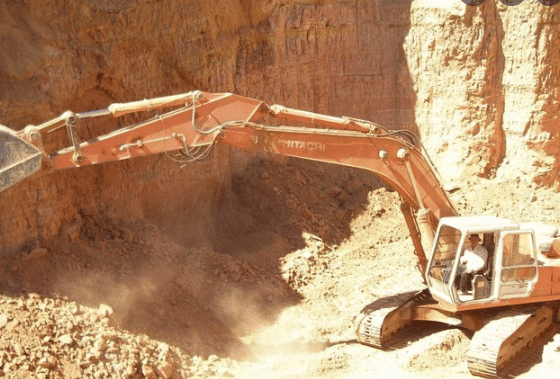
Hard to reach, its quality natural gems prove particularly rare. Imitations, on the contrary, are easy to produce.
The exploitation of natural opals
While volcanic opals are extracted within dedicated mines, sedimentary ones are gathered at the surface. They are harvested in immense deposits corresponding to ancient shallow seas. There is neither vein nor large-scale exploitation. Artisans work by hand or use small machines. Methodical and slow, the search for opals demands patience.
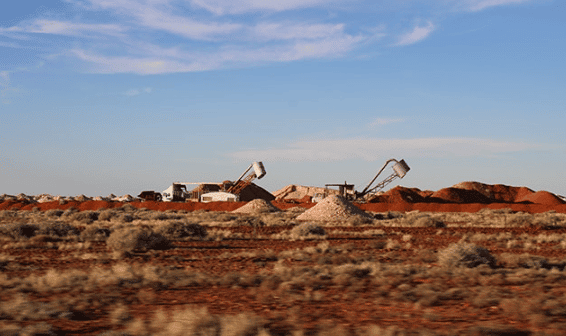
Three quarters of the crystals sold in the world come from the Coober Pedy field. The exploitation spans 70 km. After the leaching of the soils and drought, the stones rise to the surface. The clay deposits containing the gems often prove smaller than your fist.
The creation of artificial opals
On the basis of transparent materials, two techniques make it possible to shape artificial opals.
- The first uses the Stöber chemical reaction. Thanks to it, silica particles suspend within the matrix used. A decantation, followed by heating to 945 °C, completes the process. The beads set and yield milky crystals.
- The second technique consists in using a fluorine-rich glass. When it cools, it solidifies. Bound to sodium and calcium, it precipitates forming nanoparticles. They recreate the characteristic opalescence of opal.
Synthetic gems possess neither fluorescence nor phosphorescence. They suffer from numerous flaws : their extended colour field, their coarse layers, their irregular edges and their garish hues.
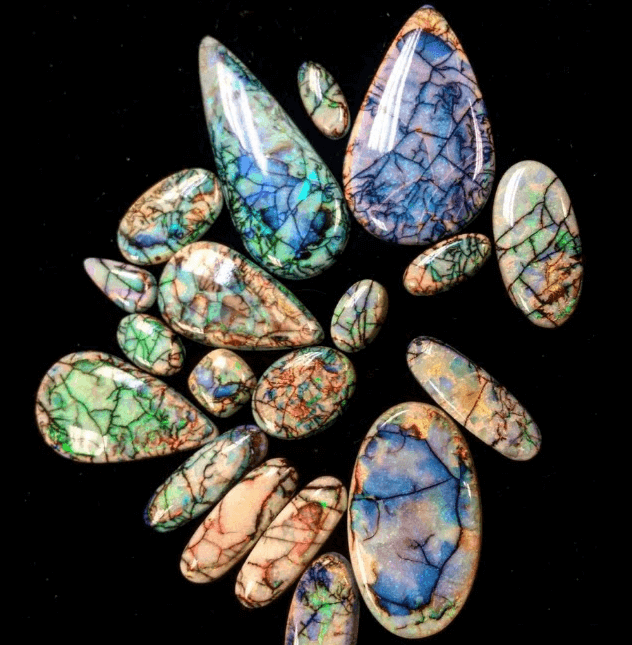
Imitations of black opals
Certain varieties of natural opal meet with no success. Artisans modify their chemistry to artificially bring their aesthetic closer to that of more prized gems. Not only do they gain in beauty, but their price remains affordable. To obtain imitations of black opals, the makers shape:
- Andamooka opal. Extracted in Queensland, Australia, this variety proves unworkable. A mixture of acid and sugar fills its pores and turns into carbon. The stone then takes on a dark hue;
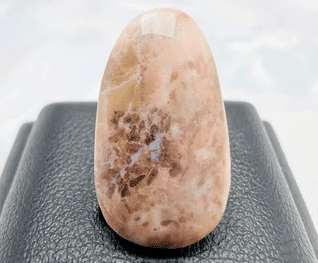
- composite opal. Layers are added to a fine-quality gem to enhance its natural value. By placing a black backing beneath the crystal, the doublet gains a shadowy brilliance. If the artisan wishes to strengthen its opalescence, they even adorn it with a transparent quartz cabochon. They obtain a triplet. Thus, the iridescence of the natural opal is multiplied and offers magnificent colours.
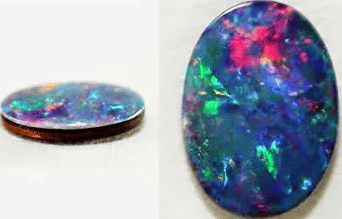
Opals throughout History
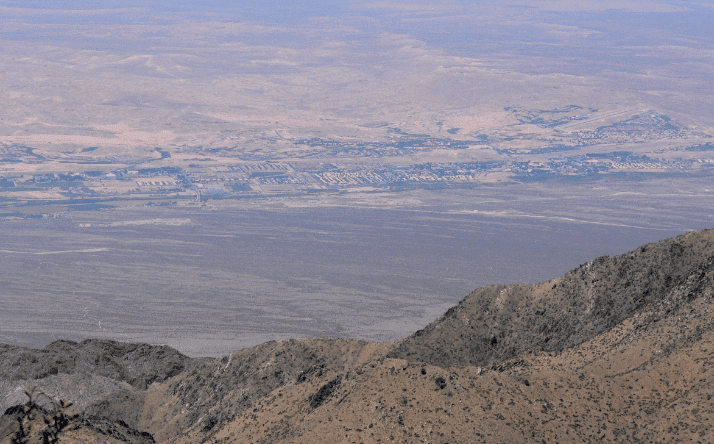
The earliest traces of human exploitation of opal date back to 10,000 years before our era. In the Virgin Valley in the United States, archaeologists discovered the first polished jewels. They bear witness to the rich history of this gem with its countless legends.
A gem deified by the Greeks
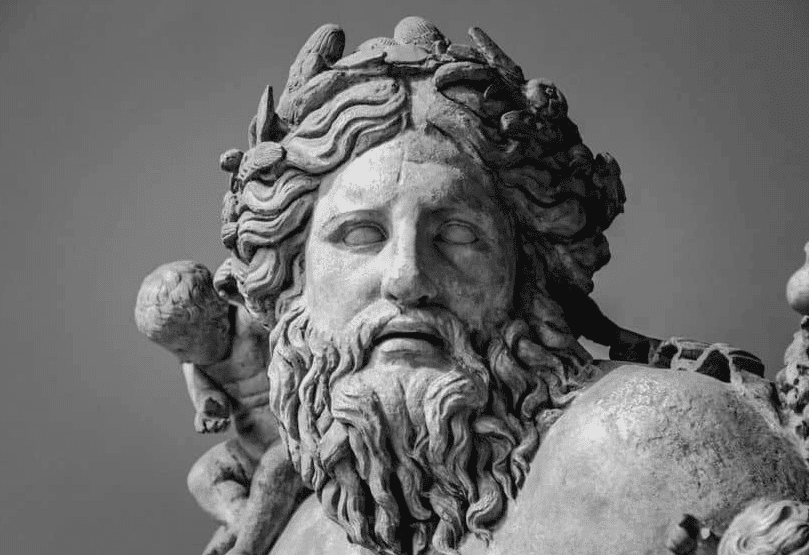
The Greeks associated opal with Zeus. Triumphing over the Titans, tears of joy rolled down his cheeks and mineralised. These stones, once the god’s tears, possess divinatory virtues.
They grant clairvoyance to those who wear them and strengthen their eyes. This belief endured until the Middle Ages.
A stone prized by the Romans
In Roman times, merchants made their fortune by importing white stones from Africa. The locals had been extracting them since 4,000 years before our era. Opal proved particularly popular under the Republic, then under the Empire.
Mark Antony, lieutenant of Caesar, coveted the gem of senator Nonius. He hoped to offer it to Cleopatra. As the man refused to sell it to him, he was forced into exile. This famous jewel is today valued at more than €60,000.
A rock that fascinated European monarchs
Throughout history, the European monarchies adorned their royal jewels with precious stones. They greatly favoured the Hungarian white opals, as well as a few African varieties. Thanks to the work of the many prospectors in the colonies, they even imported them from across the Atlantic.
In 1849, the German geologist Johannes Menge discovered the first Australian extraction field at White Cliff.
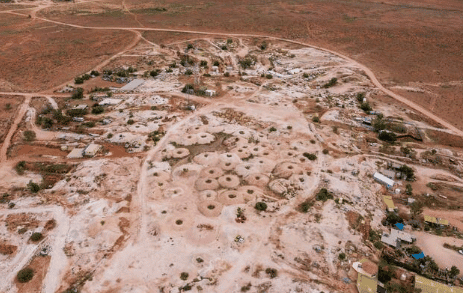
These new opalescent rocks stand out for their beauty and delighted the powerful. The multiplication of varieties and extraction sites in Oceania filled them with wonder.
A rock that marks Australian myths
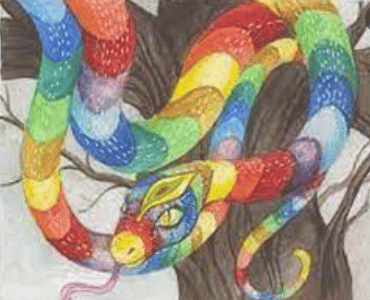
The Aboriginal Australians extracted the opalescent rock even before the arrival of European settlers. This heterogeneous people holds multiple beliefs. Among them, many traditions admire opal. They describe it as the « rainbow serpent ».
In the oral accounts, two legends coexist. According to the first, it is a deity who gathers all the colours into a single point to give birth to the gem.
The second tells that this god chases a rainbow. With each step, he gives birth to an opal.
Across the world, various cultures share these ancient myths where the rainbow is bound to this stone.
A crystal that worried Westerners

The Victorian era saw the birth of a new belief: opal was said to be cursed.
Once perceived as a good-luck charm, the gem fell from grace. This fear appeared following the publication of the novel by Walter Scott, Anne of Geierstein. The Scottish author there associates the stone with a demonic being.
Victims of the revolutions, nobles adorned with opals also died on the scaffold or during lootings, contributing to its bad reputation.
The superstition spread like wildfire.
Record-breaking and memorable opals
Some opals enter history by breaking records. The best known are:
- the Jupiter Five. Its 5 kg make it the most imposing opal in the world;
- the Persephone, polished little sister of the previous one;
- the Galaxy Opal, the largest worked gem;
- the Halley’s Comet Opal, an impressive black opal;
- the Burning of Troy, the first named opal. Napoleon I offered it to Empress Josephine de Beauharnais;
- the Queen’s Opal. It belongs to Queen Elizabeth II and is part of the British Crown Jewels;
- the Olympic Australis, the most expensive opal in the world with its 17,000 carats;
- the Flame Queen Opal. Discovered in 1914, it shows a rare singularity, an eye-shaped structure behind a unique opalescence;
- the aurora australis. Though less precious, its 180 carats forge its reputation;
- the Roebling Opal. Exhibited at the Smithsonian, this 2,585-carat gem of volcanic origin possesses exceptional colours. John Roebling offered it to the museum in 1926.
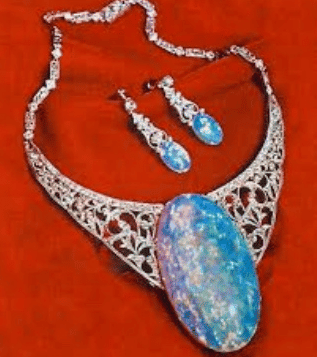
The spiritual bonds of opals
For more than 12,000 years, opal has accompanied mankind. Traditions ascribe to it protective virtues and associate it with symbolic events, such as the 21st wedding anniversary.
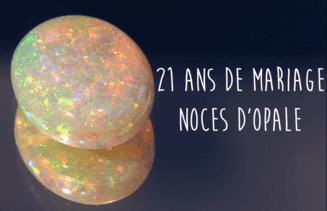
The opalescent stone is found in the great esoteric currents and now holds an important place in various cultures.
Opal and the Buddhist chakras
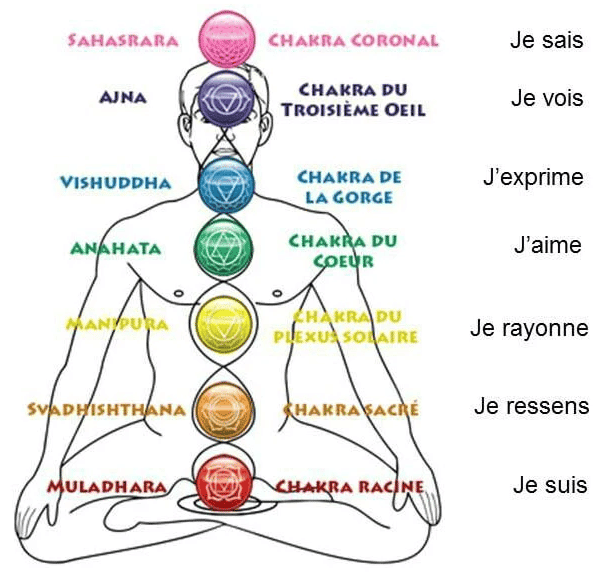
Opals are linked to chakras.
Depending on their variety, they act on different energy points.
- All possess an affinity with the Root (Muladhara), but it is above all the fire gems that deepen this bond.
- Black, white and boulder opals favour the Crown (Sahasrara),
- while matrix opals reveal their full potential in contact with the Sacral (Svadhisthana).
- Green opals favour the Heart (Anahata)
- dendritic ones the Third Eye (Ajna).
Far from attuning to a single chakra, opalescent stones stabilise all of your energy centres.
Opal and the astrological signs
Whatever your astrological sign, a variety of opal is bound to suit you. The correspondences vary according to the astrologers. The great diversity of opalescent stones nonetheless ensures you find a gem linked to your constellation:
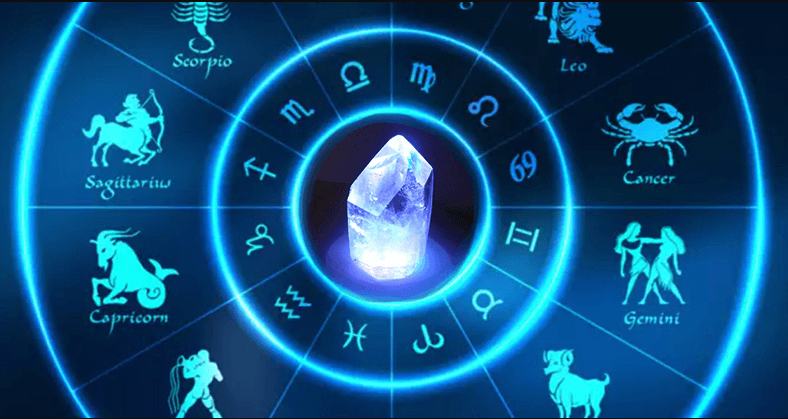
- black opal favours the signs of Taurus and Scorpio ;
- white favours Capricorn and Virgo ;
- green binds to Libra and Aries ;
- boulder and matrix shine in the hands of Aquarius and Pisces ;
- fire brings bliss to Leo and Sagittarius ;
- dendritic suits Cancer and Gemini ;
- crystal adapts to all the signs of the zodiac.
Alternative medicines and opals
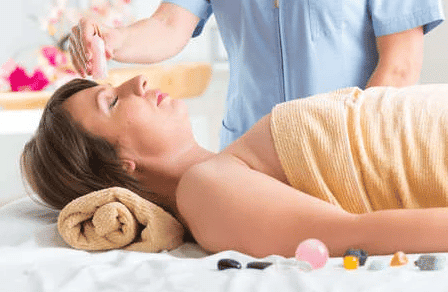
Modern man disconnects from nature. He turns his back on its beauty and ignores its benefits. Dogmatically rejecting alternative theories, modern science abandons the spiritual part of our lives. It proves cold, distant from its patients.
The development of alternative medicines answers a need for warmth and closeness. These unconventional practices place the human being back at the heart of their concerns and cultivate the knowledge of our ancestors. Inspired by the traditions of many peoples, they entrust to the stones the well-being of bodies and souls.
The prevention of feng shui
Feng shui orders your living space. The strict rules of this thousand-year-old Chinese art harmonise the energies of your home and purify your environment. Rid of its harmful pollutions, your dwelling increases your inner strength, your vitality and improves your well-being.
Opal is a feminine stone linked to yin and water. It accompanies motherhood and the development of ladies. Placed in the north, it supports your career and your professional success.
The discernment of dowsing
Dowsing deciphers the world. Equipped with a pendulum and a Bovis board, the practitioner follows and reads the movements of nature’s energies. They perceive the flows, detect objects, discern the future and diagnose the ills that affect your three bodies.
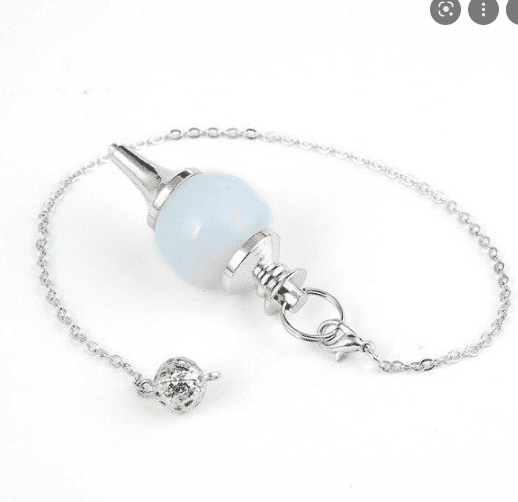
Opal suits all dowsing practices. Its harmonious vibrations support intuition and ease access to the spiritual world. Without any real weakness, this stone adapts perfectly to beginners.
The wisdom of lithotherapy
Thanks to the energetic potential of stones, lithotherapy supports your healing. It strengthens and amplifies the natural strength of your three bodies.
As early as Prehistory, men resorted to the power of gems and shaped them into jewels. They sensed their benefits and granted them an intuitive trust.
We know the extraordinary potential of gems. Experienced artisans select stones as beautiful as they are powerful. For you, they craft fine quality jewels.
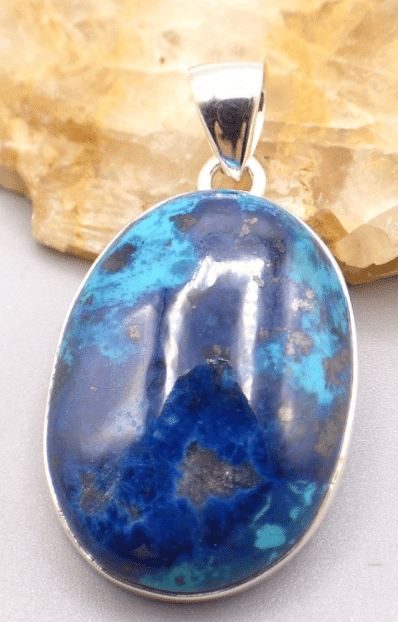
Opal bracelets and pendants are intended for a lithotherapeutic practice.
Please note: our guides constitute neither a promise nor a sourced scientific opinion. The benefits and virtues of the stones presented on our site are indicative. They stem from beliefs. Far from healing you on their own, gems support your natural capacity for regeneration. None replaces the informed opinion of a doctor or a treatment prescribed by a health professional.
Maintaining and revitalising your opals
Stones possess powerful benefits and their prolonged use discharges their energetic potential. In lithotherapy, the upkeep of your gems is crucial. In the long run, neglecting it turns against you. Thanks to simple rituals, cleanse them and rid them of their vibratory pollution. Follow these few pieces of advice and you will reconnect with the virtues of your opal.
Purifying your opal
Before restoring its vibratory potential to a stone, you must discharge it of its residual energies.
The purification ritual differs from one gem to another. While certain varieties of opal reveal their magnificent colours under water, the majority do not appreciate moisture. We therefore advise against immersion practices, however common in lithotherapy.
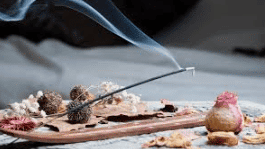
Prefer methods that respect your stone : incense fumigation, Buddhist mantras or burial in the earth.
Recharging your opal
After the purification, recharge your opal. A simple exposure to the sun is enough. Favour the morning or the evening, when its rays weaken. You will thus avoid reducing the opalescence of your stone.

You can also place it inside a geode of rock crystal or amethyst. It purifies and recharges it at the same time. Take care, however, of scratches.
A vast choice of lithotherapeutic opals
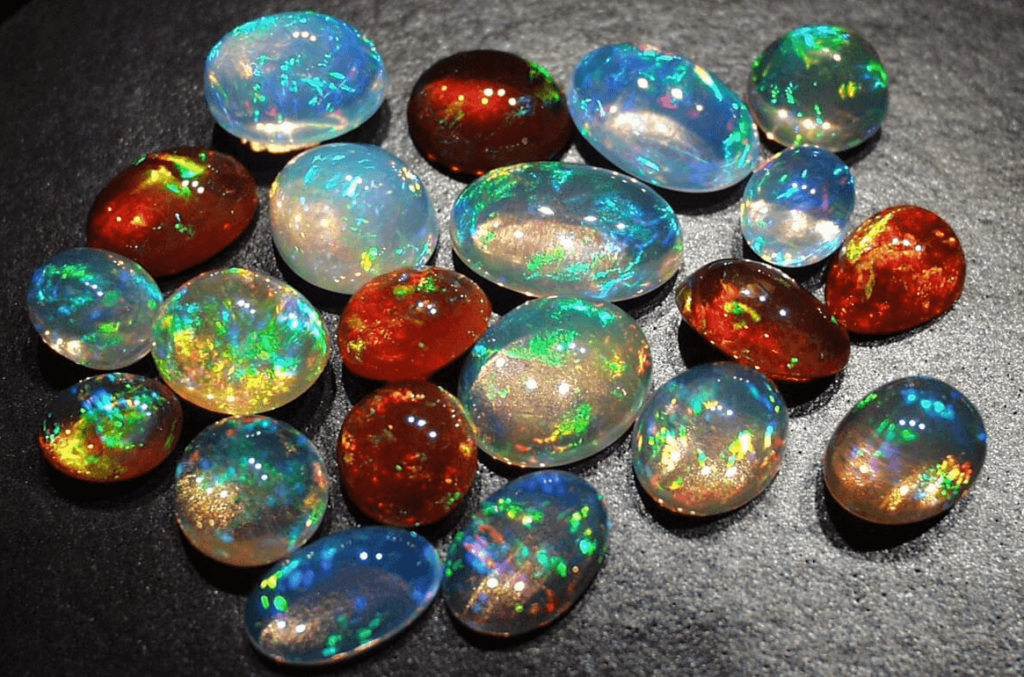
Opals gather an immense diversity of gems. Each possesses its specificities and stands out as much by its composition as by its aesthetic. Owing to the great number of varieties, species and subspecies, it is hard to be exhaustive.
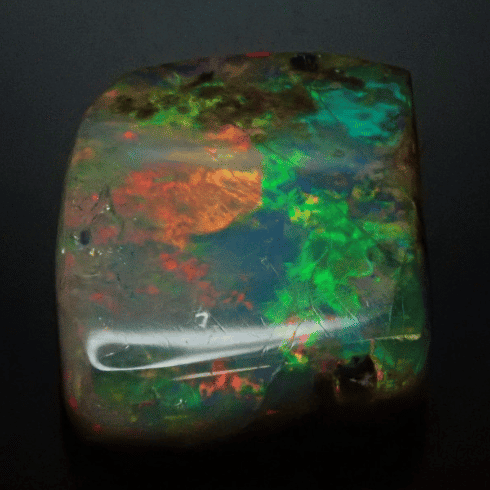
Black opals
Black opal stands out by its dark body (black variety) or grey (dark variety), owing to the presence of carbon and iron oxide. Thanks to its inclusions of opalescent flashes, it resembles a miniature cosmos.
The best-known variety comes from the Lightning Ridge deposit, in Australia.
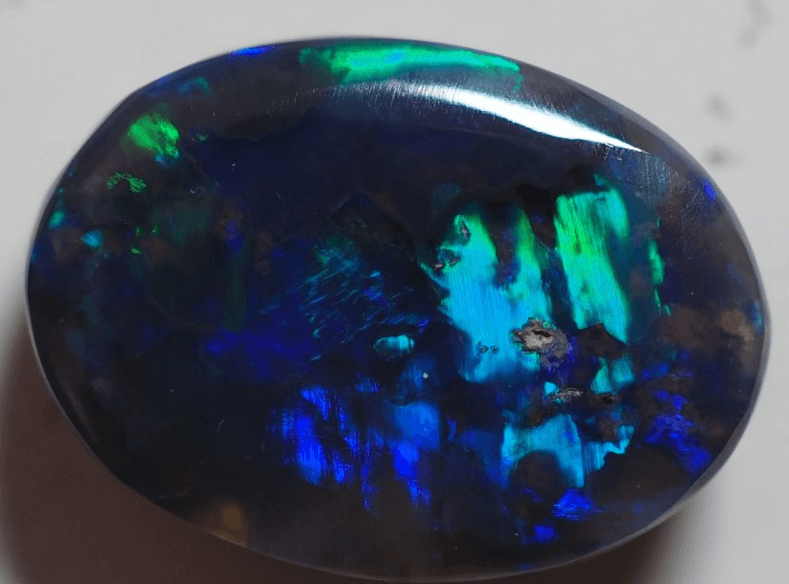
Less appreciated, the Virgin Valley opal, in the United States, is of volcanic origin. It is characterised by its blue, red, green and violet reflections. One last exploitation exists in Honduras. Their opals are recognised by their basaltic or andesitic base.
White opals
White opal sets itself apart by its milky appearance. It contains numerous flashes, generally orange. Abundant on the planet, this variety proves common in jewellery. It adorns the jewels of royal families. The various white opals are:
- those from the Czech Republic, Hungary and Slovakia. Considered the oldest in Europe, their mines are now closed. These gems, renowned for their incredible quality, fetch a fortune on the market;
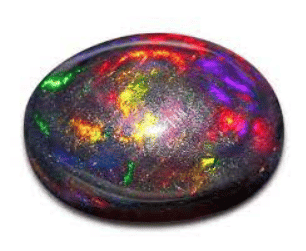
- those from Coober Pedy. They replaced the previous ones at the end of the 19th century. They possess a deep milky background and intense colours;
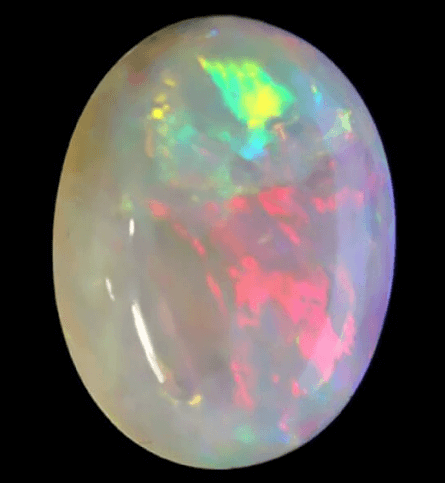
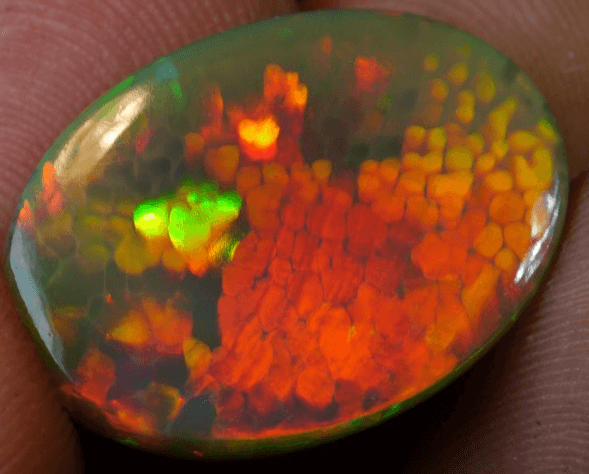
- the Ethiopian ones from Wello. Curiosities of nature, these white stones bear a unique pattern, the honeycomb. This takes the form of cells and offers internal luminous reflections that are yellow or orange. Described as harlequins or snake skins, some are distinguished by blue-violet reflections.
Green opals
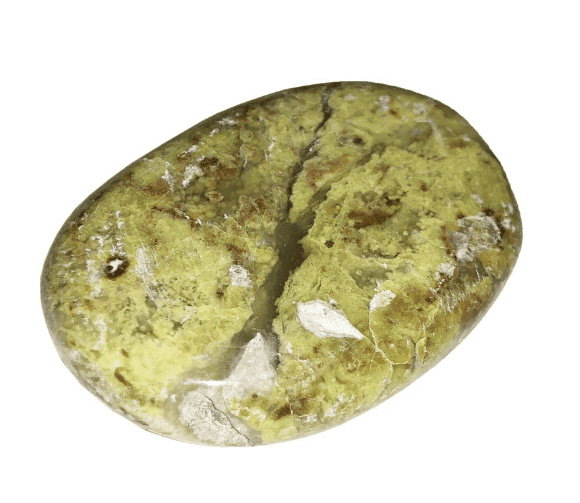
Serpentine inclusions give green opal its characteristic colour. Whatever its base of origin, these silicates change the nature of the gem. These mixed stones appear in all of the deposits blending the two rocks : in Australia, Brazil, the United States, Hungary, India, Madagascar, Mexico, the Czech Republic, etc.
Crystal opals
From transparent to translucent, crystal opal is close to hyaline quartz. Its internal colours prove particularly clear and deep. Even if its exploitation remains limited, there exist a great number of varieties :
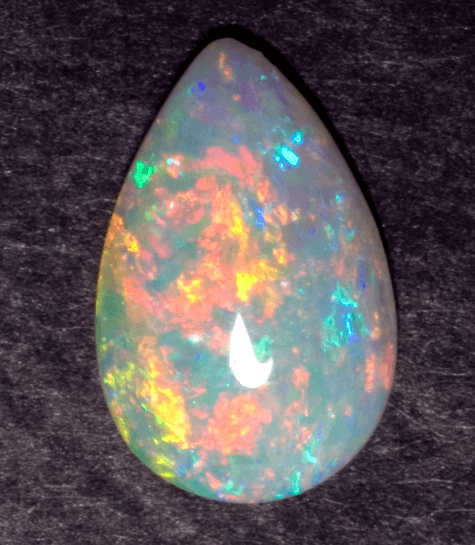
- the Lightning Ridge. Extracted with black opals in the eponymous deposit, it contains traces of carbon that darken it;
- the « Contraluz » . Its volcanic origin sets it apart from most rocks of its family. Rare, it is found in small quantity on the Australian shores and in Mexico. It possesses incredible plays of colour;
- the Brazilian. Issued from the Liamo and Lemao mines, this semi-translucent gem has a lower water content behind its marked opalescence;
- the Peruvian. Similar to quartz, its composition clearly sets it apart from other opals. There are green, pink and blue ones;
- the Mexican. It comes from the volcanic high plateaus. Although it is crystalline, it bears yellow, orange or red hues, close to the fire gem;
- the Ethiopian. Originating from the Wello region, it possesses striking brilliant facets;
- the Slovak. The crystalline stones of Dubník enjoy a unique purity and milky nacre. Their extraction site being closed today, the variety is mainly observed in museums.
Boulder opals
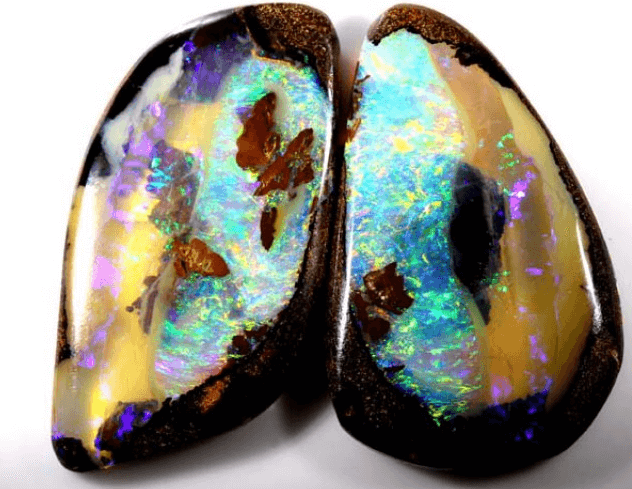
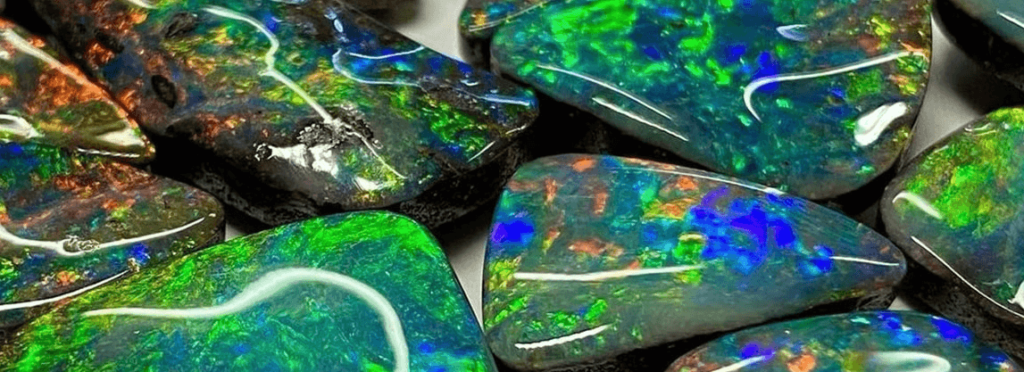
Encrusted on a layer of iron-rich sandstone, boulder opal presents itself in the form of mineral veins. Once polished, the gem, very thin on its bed of stones, reveals a magnificent opalescence scattered with colours. The majority of these opals come from Queensland, in Australia.
Matrix opals
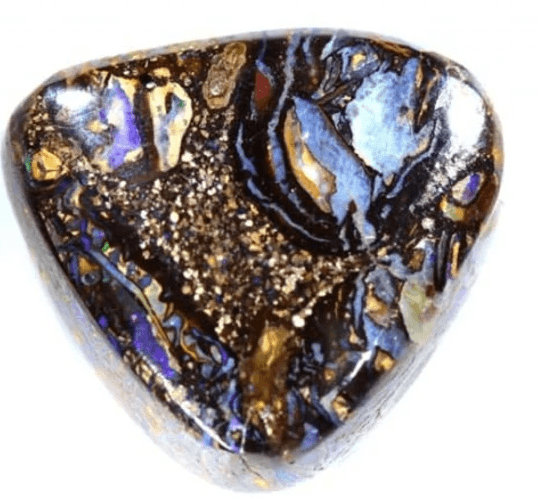
Matrix opal shares the specificity of the boulder: a host mother rock. Its thicker crystalline layer seeps in veins through the ferruginous sandstone. Its representative variety is the Queensland koroit. With its quartz base, the louisiana moves away from it and offers varied colours: blue, red, green, violet. A last volcanic variety comes from the eruptions of Honduras.
Fire opals
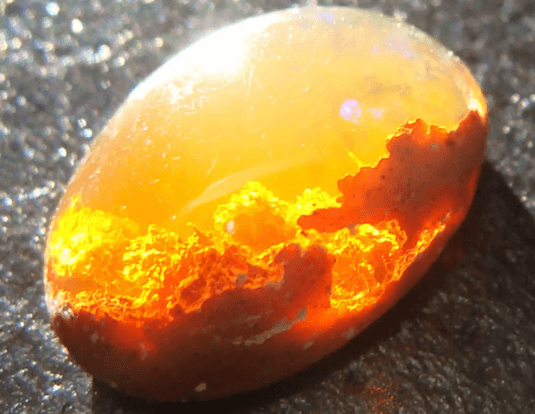
The rich yellow, red and orange hues of fire opal reflect the heat of flames. This stone, present within volcanic rocks, exists in crystalline variety as well as matrix. Since 1835, it is extracted from the Querétaro mines in Mexico. A few have also been discovered in the past in Guatemala.
Dendritic opals
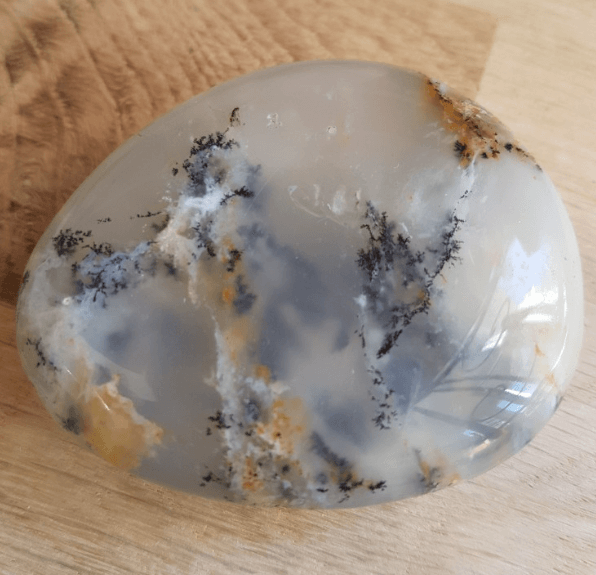
Dendritic opal contains inclusions of silica, manganese and iron with fern-like shapes. Already exploited 4,000 years before our era, the Kenyan and Tanzanian ones deploy an impressive panel of colours, ranging from yellow to green. The honey hues prove particularly appreciated in jewellery. The Turkish varieties, for their part, present a milky appearance.
Rare opals
Certain opal varieties are unique. They appear only in small quantity in a few regions of the globe. Almost absent from the Western market, these gems possess a singular potential.
The leopard opal
Rediscovered in the late 2010s, the leopard is an opalised basalt. The vesicles of the rock fill with crystals of shimmering play of light. Because of its brilliance close to a bird’s plumage, the Aztecs name it the « hummingbird stone ». Extracted in small quantity (less than 200 kg per year), it remains costly to import.
The hyalite opal
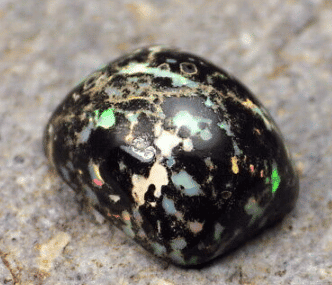
Closer to hyaline quartz, the opal of the Czech Republic is born from a silica deposit in a volcanic environment. It undergoes the high temperature and consequently takes the shape of a bunch of grapes. Colourless and glassy, its internal inclusions offer it delightful plays of colour.
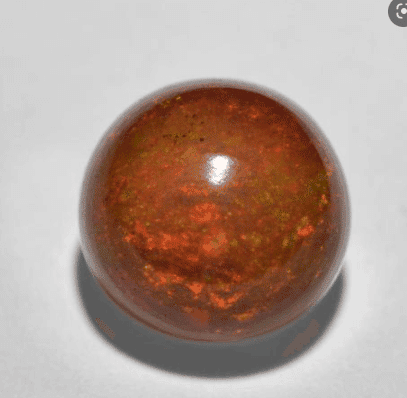
The chocolate opal
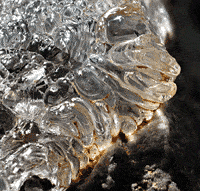
In the early ’90s, gem seekers discovered a new type of rough crystal. They noticed its interior nodule of a deep brown and named it chocolate opal. Of volcanic origin, this stone proves rather rare within its geological layer. Only one in a hundred offers a play of colours ! As extraction progressed, the miners brought to light new hues: blue, yellow, green and red.
The Java opal
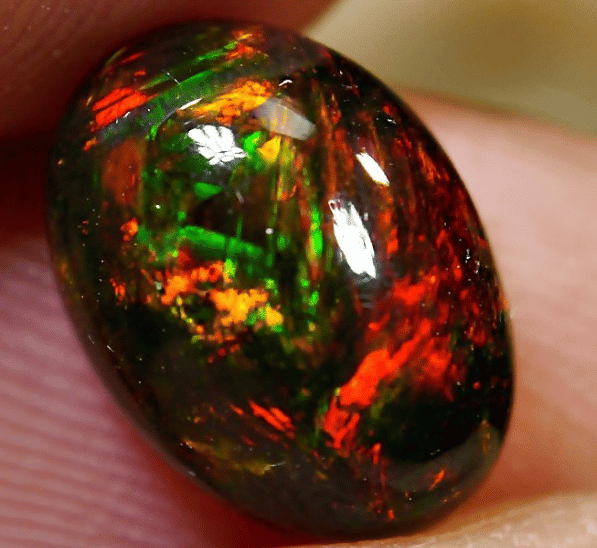
Java opal is confined to Indonesia. Extracted in small quantity, this crystalline variety is reserved for the country’s domestic market and exports little to our regions. Its difficult exploitation is carried out in the open air and by hand in muddy water. Once washed, the gem offers internal plays of light that are extremely colourful and vivid.
False opals
Certain gems sometimes wrongly bear the name opal. While these misuses of language prove forbidden by the International Confederation of Jewellery, Silverware, Diamonds, Pearls and Stones (CIBJO), they remain common. They concern:
- blue opal, which designates lazulite;
- Ceylon or celestial opal, which is a moonstone;
- Chinese opal, which describes a variety of chalcedony.
Lithotherapeutic benefits and virtues of opals
The various opals share common beneficial effects. Their similar vibratory potentials explain their collective expression of certain benefits. Nonetheless, their mineral variations bring about specific virtues in each one. Ideal in lithotherapy, the opalescent rocks prove versatile.
The spiritual, psychological and mental virtues of opal
Many peoples recognise in this gem a powerful stone of protection. They ascribe to it virtues of preservation of the human psyche. On the spiritual plane, opal :

- intercepts the bad waves;
- protects you from negative intentions;
- amplifies your emotions;
- exalts your sexual desire;
- frees women from their inhibitions;
- eases letting go;
- strengthens fidelity;
- soothes your wounds from the past;
- improves your sleep.
The physical and bodily virtues of opal
Linked to the water element, the opalescent stone plays a role in the circulation of fluids within your body. It nourishes, revitalises and accelerates it. On the physical plane, opal :
- protects your liver and your kidneys;
- fortifies your parasympathetic system;
- reduces menstrual pain;
- increases lactation;
- hydrates your skin.
The specific virtues of opals
Each variety of opal possesses its own benefits on the physical and spiritual planes:
- the black develops your creativity. It heightens your imagination and strengthens your memory;
- the white brings you stability in daily life. By consolidating your bonds with the divine forces, it improves your self-confidence;
- the green acts directly on your digestive organs. It soothes stomach aches and wards off intestinal illnesses;
- the crystal brings out the best of yourself. It helps you to love yourself in daily life. It also acts on all of your energy centres and stabilises them;
- the boulder harmonises your chakras. By freeing you from your blockages, it favours the good circulation of your spiritual energies;
- the matrix roots you in reality. At its contact, your body gains in vitality and your blood circulates with vigour;
- the fire stirs your ambition and firms your resolutions;
- the dendritic purifies your body of the pollutants that weaken you. It strengthens you physically.
No products found.
You will also like




This page does not contain child posts!
SOMMAIRE