
Dog of Spades Reading
Now there’s an odd name for a reading, some might think! That’s true, but to be more precise, what we call the Dog of Spades is the Jack of Spades found in any good traditional deck of cards, within the reading of the same name.
It is, moreover, a very famous reading in cartomancy, which reveals a very near future to the querent. So much so that during this divination session, the cards can predict events that will take place in the hours ahead. Suffice it to say that this Dog of Spades reading is as effective as it is easy to perform.
What are the specific features of the Dog of Spades?
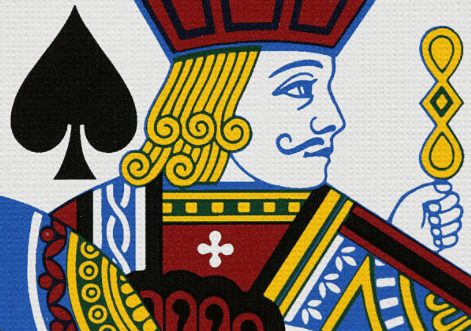
First of all, you should know that the Dog of Spades reading uses 5 essential cards known as the « centrepieces » of the reading. So we have our Jack of Spades, or Dog of Spades to be exact, the Ace of Hearts, the 7 of Clubs, the 9 of Clubs, and one card of your choice from the examples below that will represent the querent during the reading. The cards that can represent us are:
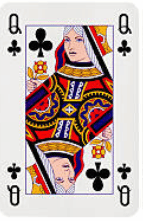
- The Jack of Hearts for fair-haired young men.
- The Jack of Clubs for dark-haired young men.
- The Queen of Hearts for fair-haired young women.
- The Queen of Clubs for dark-haired young women.
- The King of Hearts for fair-haired mature men.
- The King of Clubs for dark-haired mature men.
- The Queen of Spades for mature women, whether fair or dark-haired.
- The King of Spades for widowed or single men and women over 65.
Once you have grasped these few basic rules and chosen the card representing you, the querent must then thoroughly shuffle the 32-card deck, so that the cards are as well mixed together as possible.
How to carry out the Dog of Spades reading?
This reading now consists of cutting our pack of cards into 2 parts of 16 cards each. Then drawing cards from each pack to obtain a pair. And if ever in this pair we come across 1 or 2 of the 5 key cards, we set them aside flat on the table, with the card accompanying them.
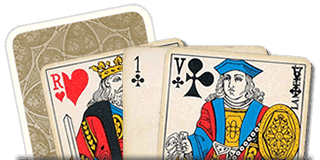
Once the operation has been repeated until both packs of cards are exhausted, we find ourselves with our 5 key cards laid out before us, in the order in which they appeared during the reading. Beneath each of these 5 key cards lies the accompanying card, which will be essential during the interpretation that is the next stage.
Interpreting the drawn cards
It will be clear that it is therefore the order in which they were drawn, and the nature of the card accompanying them to form the pair, that will be significant when interpreting our 5 key cards.
Thus, each of these will define a particular situation or context, while the accompanying card, with which it forms a duo or an association, will provide us with the upcoming predictions about the destiny of the querent. It is nonetheless good to know that the favoured contexts of each of the 5 key cards are as follows:
- The Dog of Spades, or Jack of Spades, will point to a surprise event, an unexpected occurrence that may be as positive as it is negative.
- The Ace of Hearts will point to everything relating to family and home.
- The 7 of Clubs will point to everything connected with thought and emotions.
- The 9 of Clubs will point to everything of a financial and professional nature.
The card representing us will therefore be our mirror neuron, and will express an event affecting us closely and coming very soon.
It is therefore according to the meanings of the cards accompanying the latter to form a couple that a prediction of the future will be revealed to the querent. It also happens that 2 key cards come out together within the same pair, in which case they should be treated twice in order to obtain two interpretations of a single pair.
Complementing your Dog of Spades reading
To manage to read the drawn cards, and thus obtain their predictions, you will of course need to know the meanings of each of the 32 cards of the traditional deck.
Without knowing them by heart, it will be enough simply to keep at your side a transcription of what they represent and of their values within cartomancy.
Finally, some who are more experienced than others complement the Dog of Spades reading with other cards to refine all the interpretations more deeply. But this calls for a certain talent that only professionals possess thanks to their extensive experience in the matter.
You may also like

SOMMAIRE