The history of cartomancy
The esoteric universe of clairvoyance is as old as the world itself. Its roots therefore lie at the very foundation of every civilisation, and many « sorcerers » and medicine men were already practising some of these arts back in antiquity.
But as for cartomancy, it only appeared in the Kingdom of Spain in the 15th century. Still highly renowned today as one of the most famous divinatory arts, we are going to follow its journey, from its origins down to our own day, when you can have your cards read in just a few clicks online.
The origins of cartomancy
Contrary to widely held beliefs that sometimes die hard, playing cards do not draw their origin from ancient Egypt. And while the great Egyptian sages of the age of the pharaohs already practised clairvoyance well enough, they in no way invented the divinatory art of predicting a person’s future through any kind of cards.
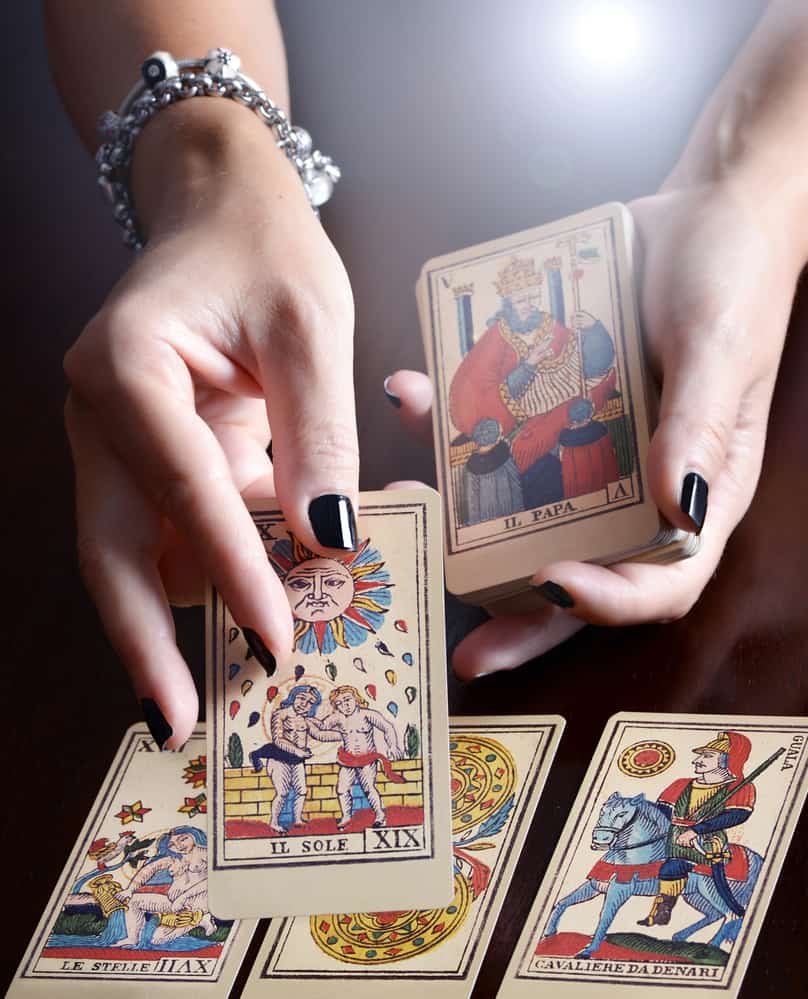
In fact, the very earliest traces of playing cards are found in India and in ancestral China, several thousand years B.C.
Shared between the dominoes and dice of the time, cards served as highly entertaining games in this part of the Eastern world, even though there is no proof that they could have been used, at that point, for divinatory purposes.
Later, it was thanks to the merchant caravans travelling the famous Silk Road that playing cards would be exported to the Middle East, reaching the Arabian Peninsula and finally Egypt under the reign of Ptolemy XII, the father of Cleopatra.
The appearance of playing cards in the West
It was therefore by reaching new cultures belonging to the great civilisations of the time that playing cards were able to develop. As in ancient Persia, for example, where the card game began to become more complete.

But very quickly, as early as the 9th century, the many migratory flows would import them into Europe and first of all among the Gypsy and Romani populations, who would adopt new ways of playing.
We know the Gypsy nomadic people’s attraction to everything connected with clairvoyance, and one cannot be mistaken in stating that they were the very first to use playing cards to make predictions about the future.
Without truly realising it, they would thus have invented what would later be called cartomancy.
The birth of the traditional deck of cards in Spain
In the Middle Ages, the Romani and Gypsy populations became integrated into most European countries, and particularly into Spain and Italy.
It was they who would therefore familiarise the locals with the practice of cards. And it was in the 15th century, within the Hispanic kingdom, that the traditional 54-card deck was created as we still know it today. It very quickly achieved great success among all sections of the population and, soon, everyone began to play thanks to new practices.
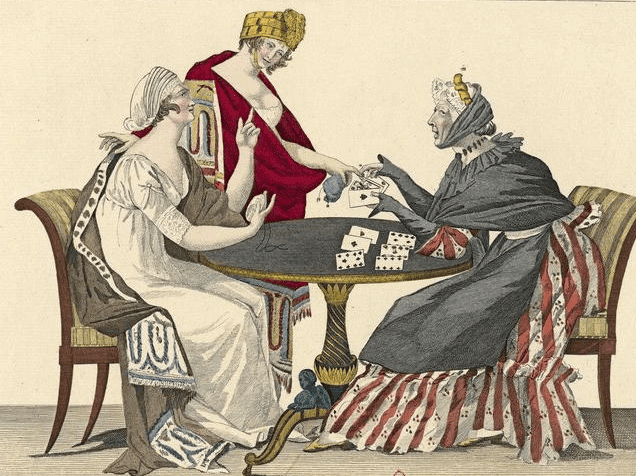
At the same time, the many seers perceived in this new 54-card deck new ways of exploring them for divinatory purposes.
It must be said that the deck is particularly rich, for it is made up of 4 suits which are clubs, spades, hearts and diamonds. Moreover, each of these suits includes 10 cards running from the Ace to the number 10 and is rounded out by court cards representing the Jack, the Queen and the King.
Cartomancy branches out into tarot
The success of this new complete deck of cards quickly went beyond the borders of Spain to reach Italy, then France.
It was therefore the Italians’ turn to take a great interest in it, all the more so as the Romani population had become well established among them and was beginning to practise the divinatory art through the interpretation of cards.
While this practice may arouse some criticism among the population, it nonetheless remains intriguing, even appealing to some who see in it a meaningful evolution.
It was thus that the creation of the very first tarot card deck would take place in 1425, to be named « tarocchi », and which would entice many minds within medieval Italy.
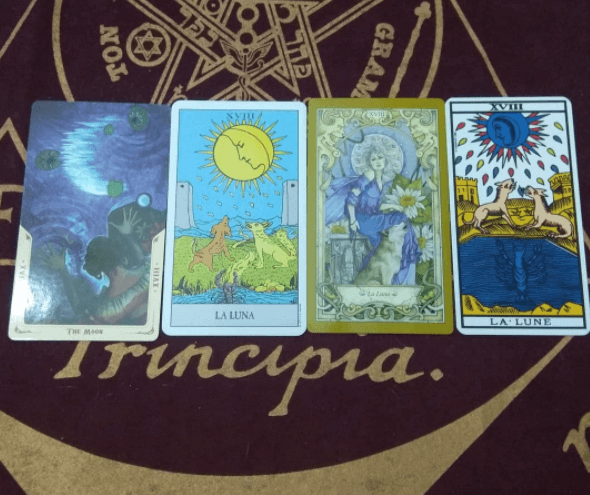
Established and designed at the request of the immensely wealthy Filippo Maria Visconti, then Duke of Milan and a great enthusiast of all things related to games, this tarot card deck would thus be the first to be composed of 16 major cards. Among these, 4 represented the virtues, 4 indicated riches, 4 symbolised the renowned maidens and finally 4 embodied all the pleasures of life.
It is worth noting that astrology was already referenced through cards depicting planets of our solar system such as Mercury and Venus.
Of this ancestor of the tarot deck, sadly no copy remains today, just a few notes allowing us to imagine it. Of course, seers saw in this tarot deck extraordinary new prospects for future card readings, but they were the only ones. Indeed, it did not enjoy the hoped-for success with the public and the Italians even rather neglected it.
But it was in France that it would meet with legendary success.
France discovers the tarot deck
It was in the middle of the 15th century that France took over this card game brought from Italy, which would see its name transformed into « tarot ». It was an immediate resounding success, all the more so as the industrial invention that was the printing press would favour its wide distribution.
Very quickly new tarot card decks were designed, based on their Italian ancestor but taking on a few new directions that were somewhat more esoteric.
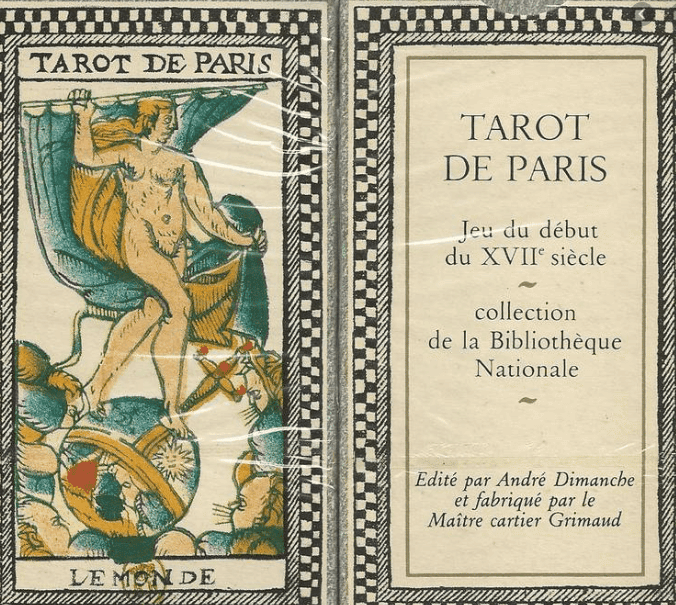
Thus, the tarots of Catelin Geoffroy and the new tarots of Paris came into being at the start of the 16th century, but it was indeed the arrival of the Tarot of Marseille that would increase the popularity of cartomancy throughout the whole country.
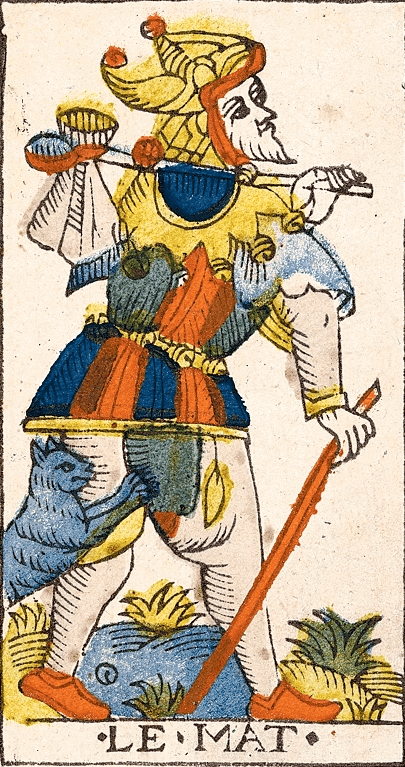
The Tarot of Marseille deck is made up of 78 cards, each more beautiful than the last, thanks to the magnificent illustrations printed upon them.
Illustrations which, on each of the cards, symbolise a particular trait linked to human nature. Among these 78 cards, we find 22 major arcana known as trumps, including one named the Fool which on its own symbolises the initiatory journey travelled through all the other cards. We also come across the 56 minor arcana, which are divided into 4 suits or signs named Cups, Swords, Wands and Pentacles.
Within each of these suits, there are 10 cards running from the Ace to no. 10, but also a Knight, a Page, a Queen and a King.
Very quickly, this more than complete tarot card deck would delight all the professionals of clairvoyance and their ever more numerous clients.
The meteoric success of the Tarot of Marseille
It must be said that in those days, fortune-tellers were many, encountered along the roadsides, in taverns and even within the royal courts.
While a few still practised reading the lines of the hand to predict a client’s future, the majority of them now used the famous Tarot of Marseille.
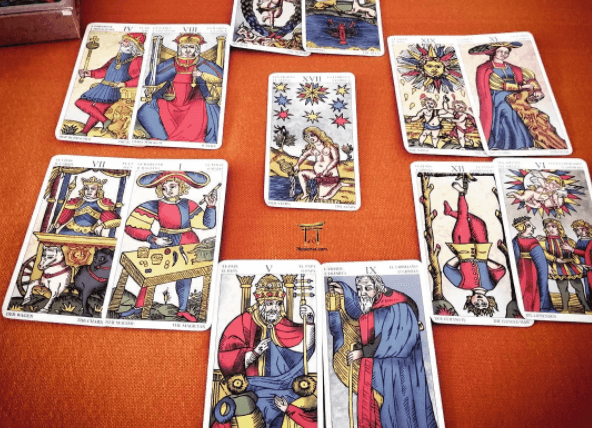
It was thus that all social classes of the French population would have their cards read to learn a glimpse of their future.
This success was very lucrative for the fortune-tellers who, often Bohemians, came from the lowest social classes and generally lived as a family within a makeshift caravan. Suddenly, their horizon of the future brightened and they could glimpse the days ahead under more favourable auspices.
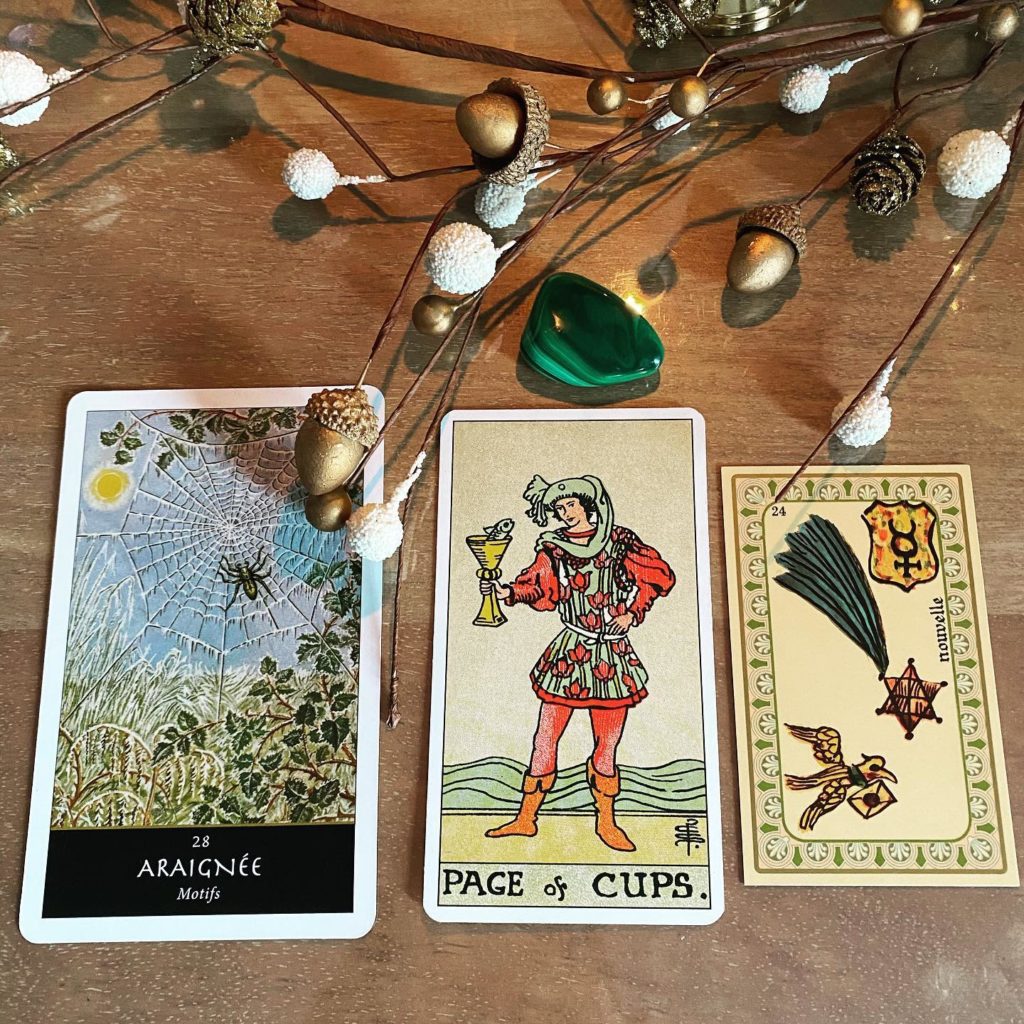
Soon, other tarot decks came into being, such as the Oracle of Belline reading or the Rider-Waite on the English side, both designed by renowned occultists, yet the Tarot of Marseille remained alone at the top of the bill.
Clairvoyance in the 20th and 21st century
After the advent of industrialisation and the upheavals caused by the two great world wars, the world is no longer the same and the practitioners of the divinatory art have had time to see the wind change.
Not to say that the world of clairvoyance had vanished from the radar, but simply that it had to adapt to all the changes that came about in the century of modernity.
And from the 1950s onwards, fortune-tellers bounced back by opening private practices in which to exercise their gifts. Without recovering the success of bygone days, they would continue to satisfy the curiosity of clients, who could not be satisfied with horoscopes they found hardly credible in their eyes.

Then, at the dawn of the 21st century, the cartomancers, often having become tarot readers, would let go of the theatrical side of their profession to make way for more pragmatism in their predictions.
Today, they most often practise online or by telephone, thanks to technological innovations, which allows them to provide a session to anyone who wishes for one.
You will also like

SOMMAIRE